
How Much Should You Raise? Sizing Your Startup Capital Round
A practical way to size a startup capital raise, how much dilution is normal, and how to think about setting a valuation.

Introduction
“How much should I raise?” is one of the first questions founders face once they decide to raise capital for their startup, and it’s easy to get wrong in both directions. Raise too little and you’re back fundraising again in six months; raise too much too early and you give up more of the company than the milestone actually required.
This guide walks through a practical way to size a startup capital raise, how much dilution is reasonable to expect, and how to think about setting a valuation without over-optimising the number.
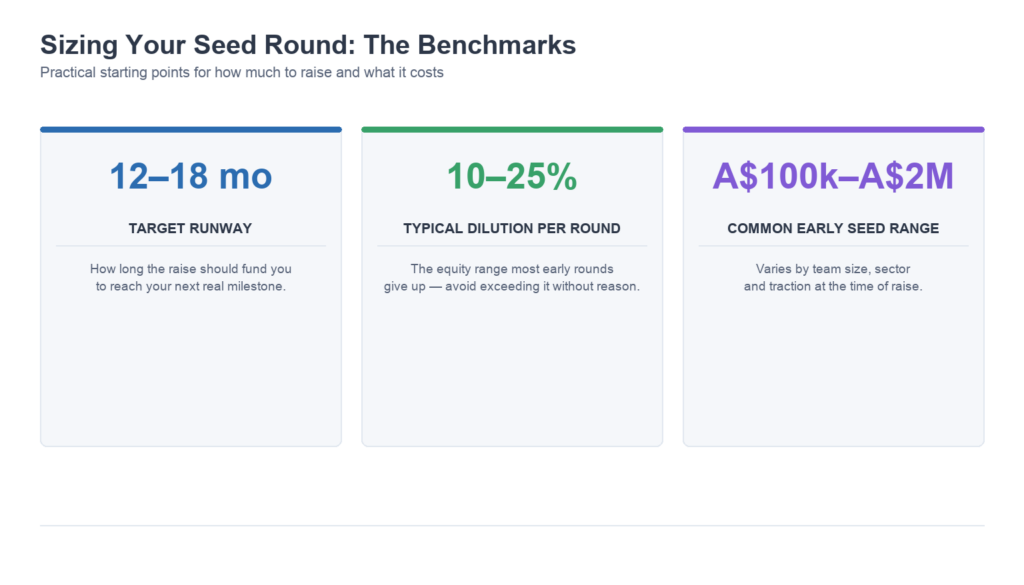
Quick answer: A good starting point is to raise enough to fund 12–18 months of runway to your next meaningful milestone, aiming to give up somewhere between 10% and 25% of the company in the process. Valuation matters less than most founders assume — the goal is a number that’s fair enough to close the round, not the highest number you can extract.
What Does “Sizing a Raise” Actually Mean?
Sizing a raise means working out how much capital gets you to your next fundable milestone — usually 12 to 18 months away — without giving up more equity than necessary to get there. It’s a runway calculation first and a valuation negotiation second.
Why Sizing the Raise Correctly Matters
Raising too little creates a scramble to fundraise again before you’ve proven enough progress to justify a higher valuation, often on worse terms than if you’d waited. Raising too much too early can remove the constraints that force a small team to focus, and unnecessarily dilutes founders for capital that isn’t actually needed yet.
- A round sized around a clear milestone gives investors a believable story for what their money buys.
- Reasonable dilution in early rounds protects your ownership for the rounds that come later.
- A well-reasoned “why this amount” answer is more persuasive to investors than an arbitrary round number.
- Multiple funding scenarios (raising the full amount vs a smaller amount) show investors you’ve thought it through.
Benefits of a Disciplined Approach to Sizing
- Cleaner cap table — less unnecessary dilution in early rounds preserves flexibility later.
- Stronger investor confidence — a runway-based number tied to a milestone reads as considered, not arbitrary.
- Less fundraising fatigue — sizing correctly reduces the chance of being back on the raise trail sooner than planned.
- Room to negotiate — presenting a range of scenarios gives you flexibility if you raise slightly more or less than the ideal number.
Risks and Challenges When Sizing a Round
- Under-raising. A round too small to reach a real milestone can force a second raise from a position of weakness.
- Over-raising. Taking on too much capital too early can dilute founders unnecessarily and remove healthy constraints on focus.
- Over-optimising valuation. Chasing the highest possible valuation can create a mismatch with reality that makes the next round harder to raise on good terms.
- Ignoring dilution creep. Multiple small raises (SAFEs, bridges) without tracking cumulative dilution can leave founders with far less ownership than expected by the priced round.
A Practical Way to Size Your Round
| Input | Typical Range | Why It Matters |
|---|---|---|
| Target runway | 12–18 months | Long enough to reach the next fundable milestone |
| Acceptable dilution | 10%–25% per round | Balances progress against long-term ownership |
| Early seed round size | A few hundred thousand to ~A$2m | Varies by team size, sector and traction |
| Valuation approach | Let investor interest set the number | Avoids over-optimising a figure with little basis this early |
Best Practices for Sizing and Valuing Your Round
- Build your raise target from a bottom-up burn-rate calculation, not a round number that “feels right.”
- Prepare two or three scenarios (full raise, partial raise) so you can adjust smoothly if you don’t hit your top target.
- Resist the urge to chase the highest possible valuation; a fair, closeable number that doesn’t overreach protects your next round.
- Track cumulative dilution across every SAFE, convertable note or priced round, not just the current raise in isolation.
- Get an early read on valuation expectations from a trusted advisor or existing investor before setting your ask publicly.
- Factor hiring realistically into your burn-rate estimate — most founders underestimate how long it takes to fill key roles, which affects how quickly the money actually gets spent.
- Revisit your sizing if the process drags on; a target that made sense at the start of a raise may need adjusting if your runway has meaningfully shrunk by the time you close.
It’s worth remembering that the specific mix of instruments you use (SAFE, convertible note, or priced equity) affects how and when dilution is actually calculated, but the underlying sizing logic — runway to milestone, reasonable dilution band — holds regardless of which instrument you choose.
Founder Perspective
Founder perspective: The valuation you land on for an early round matters far less to your company’s long-term success than most first-time founders assume. Getting a fair deal done and getting back to building the business beats holding out for an extra percentage point of valuation that won’t meaningfully change the outcome either way.
Key Takeaways
- Size your raise around 12–18 months of runway to your next meaningful milestone, not an arbitrary number.
- Aim to give up roughly 10%–25% of the company per round; avoid exceeding that without good reason.
- Let investor interest help set your valuation rather than over-optimising a figure with little real basis this early.
- Present multiple funding scenarios so you have flexibility if you raise more or less than your ideal target.
- Track cumulative dilution across every instrument, not just the current round in isolation.
FAQ
How much should a startup raise in its first round?
A common approach is to raise enough to cover 12–18 months of runway to your next fundable milestone, which for many early Australian startups lands somewhere between a few hundred thousand dollars and roughly A$2 million.
How much dilution is normal in a seed round?
Most seed rounds involve giving up somewhere between 10% and 25% of the company; founders should be cautious about exceeding that range without a strong reason.
How do I set a valuation for my company?
Rather than applying a formula, it’s common to let investor interest and comparable company valuations guide the number, prioritising a fair, closeable figure over the highest possible one.
Is it better to raise more than I need “just in case”?
Not usually. Raising materially more than your milestone requires can mean unnecessary dilution and can remove useful constraints on early-stage focus.
What happens if I raise too little?
You risk having to fundraise again before you’ve made enough progress to justify better terms, often from a weaker negotiating position.
Should I worry about a lower valuation hurting my company long-term?
Generally not as much as founders expect. Getting a fair deal closed and returning focus to the business tends to matter more than optimising the valuation number itself.
Conclusion
Sizing a capital raise is fundamentally a runway calculation tied to a real milestone, not a guess at an impressive-sounding number. Aiming for 12–18 months of runway, keeping dilution in a reasonable 10–25% band, and letting the market help set a fair valuation gives founders the best chance of closing a round that actually serves the business.
For related reading, see our guides on SAFE vs priced equity rounds, raising capital and dilution, capital raising documents every startup needs and when and how to run a startup capital raise.