
How Pre-Seed Investors Help Fund Your Next Capital Raise
How follow-on support and later-stage introductions from a pre-seed investor shape the rest of a startup capital raise.

Introduction
What separates a merely useful pre-seed investor from a genuinely valuable one is often what happens after that first cheque clears — whether they can and will keep backing the company, and whether they actively help line up the next round.
This guide explains how follow-on support works with Australian pre-seed investors, why it matters more than founders often realise at the time of the first raise, and what to ask before accepting a term sheet.
Quick answer: Many Australian pre-seed funds invest first cheques of roughly A$100,000 to A$500,000 and reserve capital to continue investing in their strongest companies through seed and Series A. Beyond capital, the most useful pre-seed investors actively help founders prepare for and secure the next round, through warm introductions to later-stage funds and hands-on fundraising support.
What is Follow-On Support in Pre-Seed Investing?
Follow-on support is a pre-seed investor’s capacity and willingness to continue backing a company in later rounds, plus the practical help they provide getting the next raise done — introductions to later-stage investors, pitch and materials feedback, and guidance on timing and process. It’s a distinct question from whether a fund will write the first cheque at all.
Why Follow-On Support Matters More Than It First Appears
At the time of a pre-seed raise, founders are usually focused entirely on getting that first cheque signed. But the same fund’s ability to follow on, and its network of later-stage relationships, can materially change how smoothly the next one or two rounds go — sometimes more than the size of the first cheque itself.
- A fund with follow-on capacity can provide a credible signal to new investors that existing backers still believe in the company.
- Warm introductions from a pre-seed investor to seed and Series A can meaningfully shorten the next raise.
- Funds that reserve capital specifically for follow-on rounds are effectively underwriting more of a company’s early journey, not just its first milestone.
- Hands-on support with fundraising materials and process reduces founder time spent relearning fundraising mechanics each round.
Benefits of Prioritising Follow-On Capacity
- Reduced fundraising friction — an existing investor’s network and credibility can shorten the search for the next round’s investors.
- Capital continuity — funds with real reserve capacity can bridge a company through a slower fundraising market rather than forcing an urgent new search.
- Stronger signalling — continued investment from an existing backer is read by new investors as a vote of confidence.
- Less repeated groundwork — a fund experienced in guiding founders through multiple rounds brings institutional knowledge to each subsequent raise.
Risks and Challenges to Watch For
- Assuming follow-on capacity without confirming it. Not every fund reserves capital for follow-on investment; some invest only at first cheque stage by design.
- Overvaluing a big brand name over real support. A well-known fund with limited hands-on involvement can be less useful than a smaller fund genuinely invested in helping you raise the next round.
- Relying on one investor’s network alone. Even a highly connected pre-seed investor shouldn’t be your only path to the next round’s introductions.
- Uneven follow-on across a portfolio. Funds naturally prioritise follow-on capital for their strongest-performing companies, which may not always align with a founder’s own view of their progress.
The Pre-Seed to Series A Cheque Progression
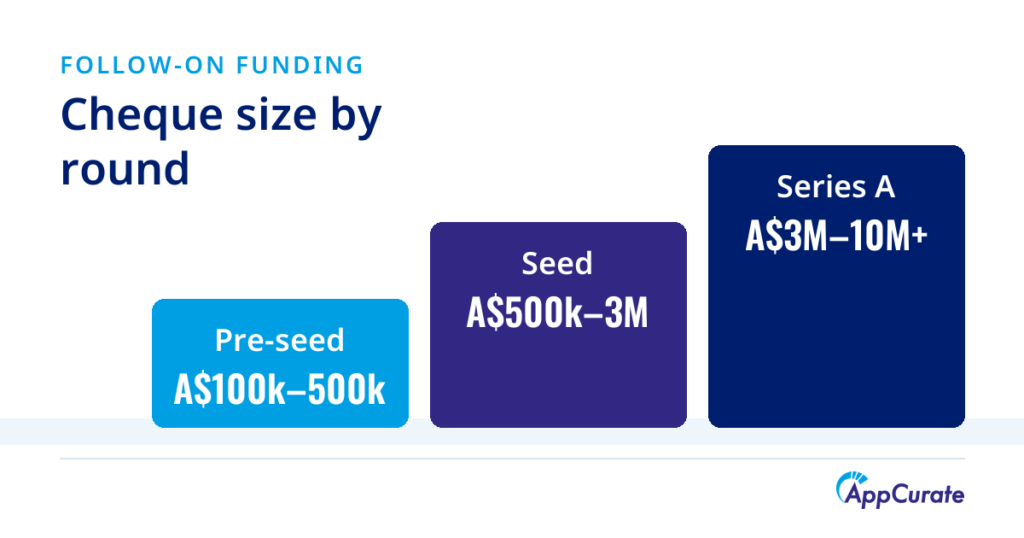
The chart below shows how typical Australian early-stage cheque sizes progress as a company moves through rounds.
| Stage | Typical Cheque Range | Common Follow-On Behaviour |
|---|---|---|
| Pre-seed | A$100k–A$500k | Initial cheque; reserve often set aside for later rounds |
| Seed | A$500k–A$3m | Pre-seed investors often follow on if performance supports it |
| Series A | A$3m–A$10m+ | New lead typically joins; earlier investors may continue pro-rata |
Best Practices for Assessing Follow-On Support
- Ask directly whether a fund reserves capital for follow-on investment, and roughly what proportion of its portfolio typically receives it.
- Ask which later-stage funds an investor has successfully introduced portfolio companies to in the past.
- Speak to founders the fund has backed through multiple rounds, not just their most recent pre-seed deal, to understand real follow-on behaviour.
- Don’t choose a pre-seed investor on follow-on promises alone; weigh it alongside cheque size, thesis fit and hands-on support.
- Keep building your own investor network independently, rather than relying solely on one fund’s introductions for the next raise.
- Clarify early whether follow-on decisions are made by the same investor you’re speaking with or require a separate internal approval process, so you know how much weight their personal enthusiasm actually carries.
- Where a fund offers hands-on fundraising support, ask for detail — reviewing decks, joining investor calls, making direct introductions — rather than accepting the claim at face value.
It’s also worth factoring in timing expectations. A fund’s willingness to follow on doesn’t remove the need to start the next raise process early; even highly supportive existing investors generally expect founders to run a proper process rather than treating a follow-on commitment as guaranteed in advance.
Founder Perspective
Founder perspective: Ask about follow-on support and later-stage introductions in your very first conversation with a prospective pre-seed investor, not after the cheque has cleared. The best pre-seed investors think of themselves as partners in your next raise as much as your current one, and that mindset shows up clearly in how specifically they can answer the question.
Key Takeaways
- Follow-on support and later-stage introductions are often as valuable as the first pre-seed cheque itself.
- Not every fund reserves capital for follow-on investment; confirm this explicitly rather than assuming it.
- Cheque sizes typically progress from roughly A$100k–A$500k at pre-seed to A$3m–A$10m+ by Series A.
- Speak to founders a fund has backed through multiple rounds to understand its real follow-on track record.
- Maintain your own investor relationships independently rather than relying entirely on one fund’s network.
FAQ
Do all pre-seed investors provide follow-on funding?
No. Some funds invest only at pre-seed by design, while others explicitly reserve capital to continue backing their strongest companies into later rounds.
How much should I expect to raise after pre-seed?
Seed rounds commonly range from roughly A$500,000 to A$3 million, with Series A rounds typically starting from around A$3 million.
Why do warm introductions from a pre-seed investor matter for the next round?
They can meaningfully shorten the search for new investors and add credibility, since a later-stage fund is more likely to engage seriously with an introduction from a trusted existing backer.
How do I find out if a fund really follows on, versus just claiming to?
Ask for specific examples and speak directly to founders the fund has backed through more than one round.
Should follow-on capacity be the main factor in choosing a pre-seed investor?
No. It’s an important factor, but should be weighed alongside cheque size, sector fit and the quality of hands-on support offered.
Can I still raise a strong seed round without my pre-seed investor following on?
Yes. Many companies raise successful next rounds without their original pre-seed investor participating; follow-on support is valuable but not the only path to a good outcome.
Conclusion
The value of a pre-seed investor extends well beyond the size of the first cheque — their capacity and willingness to follow on, and the strength of their later-stage network, can shape how smoothly the next one or two rounds go. Asking about follow-on support early, and verifying it with founders who’ve been through it, helps Australian founders choose pre-seed partners who are genuinely invested in the whole journey, not just the first milestone.
For related reading, see our guides on how much should you raise, how long it takes to raise startup capital, lead vs co-invest VC models and how to find and approach investors.