
What Documents Seed Investors Expect From Australian Startups
A guide to the documents Australian seed investors typically request - cap tables, term sheets, IP assignments and financial records - before funding a startup.

Quick Answer
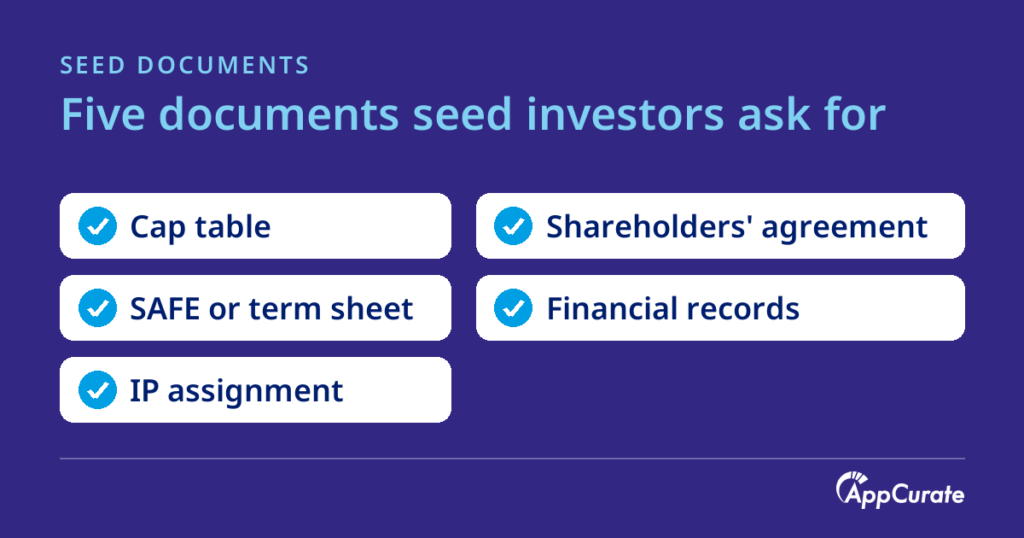
Seed investors in Australia typically ask for a capitalisation table, a SAFE or priced-round term sheet, an IP assignment schedule, a shareholders’ agreement and basic financial records before they wire funds. Founders who prepare these documents before opening a round shorten diligence, avoid renegotiation and signal that the start-up is investment-ready.
Introduction
Most first-time founders discover the paperwork side of a capital raise only after a term sheet lands in their inbox. By then, the clock is already running. Seed investors in Australia work from a fairly consistent document checklist, and knowing it in advance means a founder can prepare files during quiet weeks rather than scrambling during diligence.
This guide walks through what seed-stage investors commonly ask for, why each document matters, and how founders can get organised before they start conversations with investors.
What Documents Do Seed Investors Ask For?
A typical seed-stage document request covers company formation records, ownership and equity documents, financing instruments, intellectual property assignments and basic financial statements. Investors are not trying to catch founders out — they are checking that the company is legally clean enough to accept new capital without creating downstream problems.
1. Capitalisation Table
The cap table shows who owns what, including founders, early employees, advisers and any prior investors. Investors want to see fully diluted ownership, not just the headline share count, so option pools and convertible instruments need to be reflected accurately.
2. Financing Instrument and Term Sheet
Whether the round uses a SAFE, a convertible note or a priced equity round, investors expect a term sheet that sets out valuation cap or price, discount, pro-rata rights and any board or information rights. In Australia, SAFEs are less standardised than in the US, so founders should not assume a term sheet template downloaded from an American source will map cleanly onto local company law.
3. Constitution and Shareholders’ Agreement
A company constitution and shareholders’ agreement (or founders’ agreement, if the company is very early) set out how decisions get made, what happens if a founder leaves, and how future share issues are approved. Investors read these closely because they define what rights the investor is actually buying.
4. IP Assignment Documents
Any intellectual property built by founders, contractors or early employees needs to sit inside the company, not with an individual. Investors will ask for IP assignment agreements, particularly where a contractor built the first version of the product before incorporation.
5. Financial Records and Runway Summary
Even pre-revenue companies are expected to produce a basic profit-and-loss summary, a cash position and a runway forecast. This does not need to be audited, but it does need to be accurate and current.
Why This Documentation Matters
Clean documentation reduces the time between a verbal “yes” and money landing in the company’s account. It also protects founders: a messy cap table or an unassigned IP right can resurface at the next round and cost far more to fix later than it would have cost to sort out at seed stage.
Common Gaps Founders Should Fix Early
- Advisers or early contractors holding informal equity promises with nothing in writing.
- Option pools that exist verbally but were never formally reserved in the cap table.
- Personal bank accounts or personal contracts used for company expenses before incorporation.
- IP built before the company existed, with no assignment deed signed afterwards.
- No signed founders’ agreement covering vesting, leaver provisions or IP ownership.
Seed Documentation vs Series A Documentation
| Area | Typical Seed Stage | Typical Series A |
|---|---|---|
| Financing instrument | SAFE or convertible note, sometimes a light priced round | Priced equity round with full shareholders’ agreement |
| Financial records | Basic P&L and cash forecast | Reviewed or audited accounts, management reporting pack |
| Legal diligence depth | Cap table, IP assignment, constitution | Full legal diligence including contracts, employment, IP register |
| Board rights | Usually informal or minimal | Formal board seat or observer rights, information rights |
Founder Perspective
Founders who keep a running data room from day one — even a simple shared folder with cap table, agreements and financials — consistently move through seed diligence faster than those who assemble everything after a term sheet arrives. Treat the data room as a living document, not a one-off exercise before fundraising.
Key Takeaways
- Seed investors in Australia generally ask for a cap table, financing term sheet, constitution or shareholders’ agreement, IP assignment documents and basic financial records.
- SAFEs are less standardised in Australia than in the US, so local legal review matters before using an overseas template.
- Unassigned IP and informal equity promises are the most common gaps that slow down diligence.
- Keeping a live data room from incorporation onward shortens the time between term sheet and funds landing.
FAQ
Do pre-revenue start-ups need audited financials for a seed round?
No. Most seed investors accept an unaudited profit-and-loss summary and cash forecast, provided the numbers are accurate and current.
Is a SAFE legally binding in Australia the same way as in the US?
SAFEs are used in Australia but are less standardised than in the US market, so founders should have any SAFE reviewed against Australian company law rather than assuming a US template applies unchanged.
What happens if IP was never formally assigned to the company?
Investors will typically require the gap to be fixed with a signed IP assignment deed before completing the round, which can delay closing if it is left until diligence begins.
Do seed investors expect a formal shareholders’ agreement?
Many seed rounds proceed with a lighter constitution and side letter rather than a full shareholders’ agreement, but investors still expect clarity on decision rights and future share issues.
How early should a founder start preparing these documents?
Ideally from incorporation. Waiting until a term sheet arrives is the most common reason seed rounds take longer to close than expected.
Conclusion
The paperwork behind a seed round is predictable once a founder knows what is coming. Building a cap table, financing documents, constitution, IP assignments and basic financials early — rather than reactively — turns diligence from a bottleneck into a formality.
For related reading, see our guides on SAFE notes vs priced equity rounds and what helps a startup stand out to investors.