
When Is the Right Time to Approach Australian VCs? You’re Never Too Early
The most persistent myth in the Australian startup ecosystem is that founders must wait until they look “fundable” by conventional metrics before speaking to venture capital.

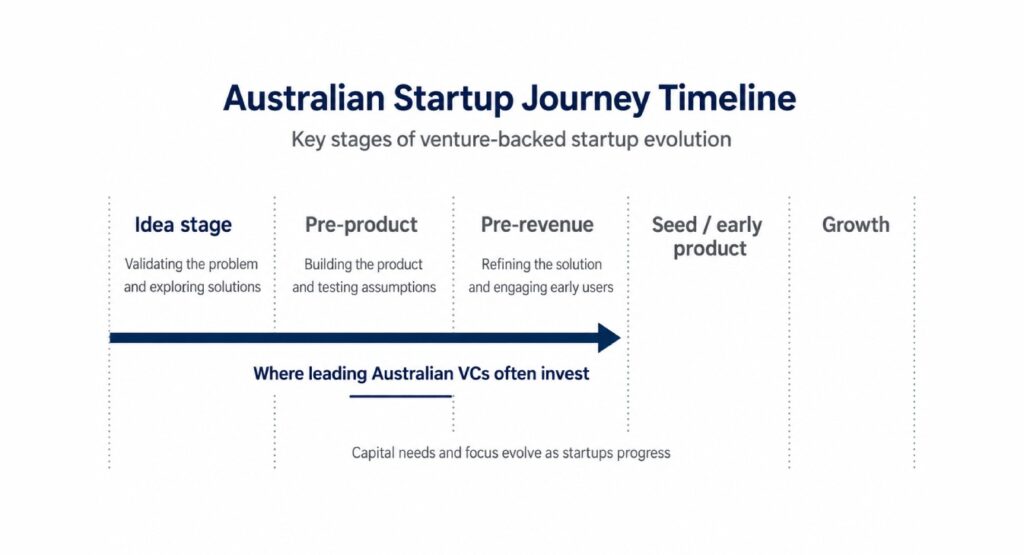
Quick answer: Leading Australian venture firms invest pre-revenue and pre-product with very small cheques, and even before a founding team is fully formed. The right time to start the conversation is as soon as you have conviction in a problem and a founder (or founders) who intend to solve it.
Many Australian founders delay reaching out to venture capital because they believe they are “too early”. They wait for product-market fit, revenue, a complete technical team, or a larger round size. In reality, some of the most successful investments in the Australian and New Zealand ecosystem began far earlier than most founders assume.
This article examines what “early” actually looks like for local venture investors, the common misconceptions that keep founders from starting conversations, and practical guidance on when and how to approach funds that explicitly prioritise the earliest stages.
What “Investing Early” Means in Practice
For a subset of Australian venture firms, early does not mean seed with a working product and early customers. It can mean:
- Pre-revenue (the majority of first cheques at some funds).
- Pre-product (around one in four investments in certain portfolios).
- Idea stage, before the company has even settled on its first market.
- Very small cheque sizes (sometimes under $50,000).
- Founders who are still in high school or early university.
- Teams that are still forming or consist of a single non-technical founder.
- Scientists and researchers who have not yet decided to become founders.
The consistent thread is belief in the founder (or founding team) rather than a checklist of traction metrics.
Why this Matters for Australian Founders
Australia and New Zealand produce ambitious founders at an accelerating rate, yet many still operate under the assumption that local venture capital only arrives once a company looks “fundable” by traditional standards. That assumption creates unnecessary delay.
When a fund is willing to invest at the earliest possible moment, three things change for the founder:
- You gain a long-term partner who has been with you from the beginning and is more likely to support subsequent rounds.
- You receive capital and counsel while the company is still highly malleable.
- You avoid the common trap of raising a larger round later from investors who have no historical relationship or context.
For investors, the same philosophy creates the opportunity to build meaningful ownership in companies that become generational.
Benefits of Engaging Venture Capital Very Early
- Relationship capital: The investors who backed you when the idea was still forming often become the most reliable long-term partners.
- Signal and network effects: An early cheque from a well-known Australian fund can open doors to talent, customers and later-stage capital.
- Freedom to explore: Capital at the idea or pre-product stage allows founders to test multiple directions without immediate pressure to hit revenue targets.
- Ownership continuity: Funds that invest early and then follow on can maintain significant ownership through later rounds rather than being diluted away.
Common Misconceptions That Delay Founders
Founders frequently self-filter with statements such as:
- “We’re still pre-revenue.”
- “We don’t have a product yet.”
- “Our team is only just coming together.”
- “We’re only raising a small amount.”
- “I’m a solo founder / non-technical founder.”
- “We’re too young.”
Each of these has been true of companies that later became major portfolio successes for early-stage Australian funds. The presence of revenue or a polished product is helpful, but it is not a prerequisite for many local investors who prioritise founder quality and ambition.
Practical Examples of How Early Australian VCs Have Invested
Historical patterns from leading local firms show consistent willingness to back:
- Companies at pure idea stage where the industry focus was still undecided.
- Founders who were still teenagers.
- Solo non-technical founders with deep domain experience.
- Teams that formed after the first conversation with the investor.
- Scientists commercialising research before they formally considered themselves entrepreneurs.
- Cheques as small as a few tens of thousands of dollars when the ambition and founder quality were high.
These cases illustrate that the limiting factor is rarely the stage of the company. It is far more often the founder’s decision to delay the conversation.
Best Practices for Founders Considering an Early Approach
- Start with conviction, not completeness. You need a clear problem, a point of view on how to solve it, and evidence that you are the right person (or team) to pursue it. You do not need a finished product or revenue.
- Be transparent about stage. Leading early-stage investors prefer honesty about how early you are. Over-polishing or claiming traction that does not yet exist usually backfires.
- Focus on the long-term relationship. The best early investors are looking for companies they can support for a decade or more. Frame the conversation around shared ambition rather than a single round.
- Do not wait for a “proper” round size. Some funds will write very small first cheques precisely because they want to be present from the beginning.
- Use programs and warm introductions where available. Many Australian funds run or support early-stage programs that lower the barrier to a first conversation.
Founder perspective: The cost of waiting until you feel “ready” is often higher than the cost of an early rejection. An early conversation that does not result in investment still provides valuable signal and can open other doors. An early conversation that does result in investment can change the entire trajectory of the company.
Investor perspective: The highest-conviction early investments are made on founder quality and the size of the ambition, not on a polished deck or early metrics. Funds that consistently invest at the earliest stages are deliberately choosing relationship and ownership over short-term de-risking.
Key Takeaways
- Several leading Australian venture firms explicitly invest pre-revenue, pre-product and at idea stage.
- Small cheque sizes, young founders, solo founders and non-technical teams are not automatic disqualifiers.
- The most common reason founders delay is self-filtering based on incomplete information about investor behaviour.
- Early investment creates the possibility of a multi-year partnership and meaningful ownership for both sides.
- The practical advice is simple: if you have conviction in a problem and the people who will solve it, start the conversation.
Actionable Checklist for Founders
- Write down the clearest version of the problem you are solving and why you are the right person to solve it.
- Identify two or three Australian funds known for investing at the earliest stages.
- Prepare a short, honest update on stage (including what does not yet exist).
- Reach out via the fund’s preferred channel or through a warm introduction if available.
- Treat the first conversation as the start of a potential long-term relationship rather than a single fundraising event.
- If the answer is not yet, ask what would make the timing better and stay in contact.
Frequently Asked Questions
Do Australian VCs invest pre-revenue?
Yes. At some leading local funds the majority of first investments in recent years have been into pre-revenue companies. Revenue is helpful but not required when the investor has high conviction in the founder.
Will Australian VCs invest before there is a product?
Yes. A meaningful percentage of early investments occur at the pre-product or pure idea stage. The decision is driven by belief in the founder and the scale of the opportunity rather than the existence of a working product.
Is a small raise a problem?
Not for funds that prioritise being first. Some of the earliest cheques written by major Australian firms have been well under $100,000. Ambition and founder quality matter more than round size at the beginning.
Do solo or non-technical founders get funded?
Yes. Several well-known Australian portfolio companies began with a solo non-technical founder who later built or hired the technical capability. Domain expertise and execution ability can outweigh the absence of a technical co-founder at the earliest stage.
How young is too young?
Age itself is rarely a barrier. Funds have invested in founders still in their late teens when the combination of insight, drive and opportunity was compelling.
When should I actually reach out?
As soon as you have genuine conviction in a problem and a clear sense that you (or your emerging team) intend to solve it. Waiting until every element is polished often means missing the window when relationship capital is most valuable.
Conclusion
The most persistent myth in the Australian startup ecosystem is that founders must wait until they look “fundable” by conventional metrics before speaking to venture capital. For a significant group of local investors, the opposite is true: the earlier the conversation, the better the chance of building a long-term partnership and meaningful ownership on both sides.
If you have conviction, start the dialogue. You’re never too early.
For related reading, see our guides on what helps a startup stand out to investors, SAFE notes vs priced equity rounds, building a strong founder-investor relationship and the Australian venture capital market.
This article provides general information only and does not constitute financial, legal or investment advice. Individual circumstances vary. Founders should always seek independent professional advice before making fundraising decisions.