
How to Match Your Startup to a VC Thesis Before You Pitch
The five factors most VCs evaluate before investing, and the questions founders should ask before pitching any fund.

Introduction
Founders often treat a VC pitch like a single, generic performance — the same deck, the same story, delivered to every fund on the list. But every fund invests against a specific thesis, and a pitch that doesn’t map to that thesis rarely gets far, no matter how strong the underlying business is. Matching your story to a fund’s actual criteria before you pitch is one of the highest-leverage things you can do when you raise capital for your startup.
This guide breaks down the criteria most funds evaluate a pitch against and the practical questions to get answered before you approach any investor.
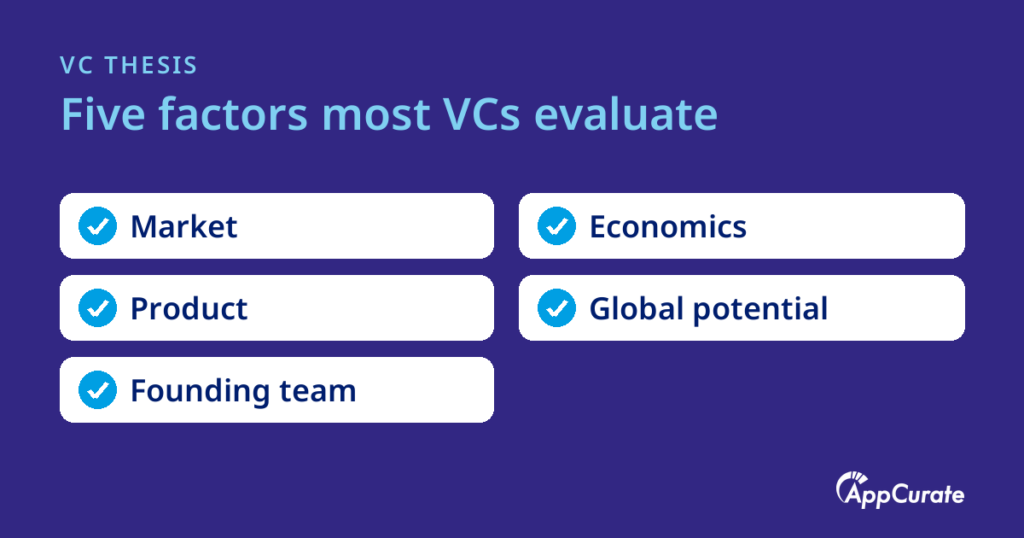
Quick answer: Most VC funds evaluate a startup against five recurring factors — the market opportunity, the product’s differentiation, the founding team, the business model’s economics, and the potential to scale globally. Understanding a fund’s specific thesis on each of these before you pitch improves your odds far more than refining your deck’s design.
What is a VC’s “Investment Thesis”?
An investment thesis is the specific set of beliefs a fund holds about where value will be created — which markets, business models, technologies or founder profiles they believe will win. It shapes every investment decision a fund makes, and pitching outside that thesis, however strong the business, rarely succeeds.
Why Thesis Fit Matters More Than a Polished Deck
A beautifully designed pitch deck can’t compensate for a fundamental mismatch with what a fund actually invests in. Founders who research a fund’s thesis before pitching save time, get more useful feedback, and are more likely to be talking to the right people from the first conversation.
- Funds turn down strong businesses regularly simply because they fall outside the current thesis.
- A pitch tailored to a fund’s specific criteria signals you’ve done your homework, which itself builds credibility.
- Understanding thesis fit helps you prioritise which funds to approach first, rather than pitching everyone identically.
- A clear thesis match makes it easier for an investor to advocate for you internally with their own investment committee.
The Five Factors Most Funds Evaluate
- Market. Is the market timing right, and is there a real tailwind or shift creating the opportunity now?
- Product. Is the product meaningfully differentiated, or an incremental improvement on existing options?
- Founder. Does the team have the determination, insight and ability to attract talent needed to execute the vision?
- Economics. Is the business model’s unit economics compelling, with a clear and efficient path to acquiring customers?
- Global potential. Is the opportunity built for one market, or does the solution scale globally from the outset?
Risks and Challenges of Ignoring Thesis Fit
- Wasted pitches. Approaching funds outside your stage, sector or thesis burns time on both sides with little chance of a meaningful outcome.
- Generic positioning. A one-size-fits-all pitch fails to speak to what any specific fund actually cares about.
- Missing the real objection. Founders sometimes assume a “no” is about the business when it’s actually a thesis mismatch that no amount of persuasion would have fixed.
- Overlooking process questions. Founders who don’t ask about a fund’s typical cheque size, stage focus or lead/co-invest preference can waste weeks pursuing a mismatched fit.
Questions to Get Answered Before You Pitch
| Question | Why It Matters |
|---|---|
| What stage do you invest at? | Avoids pitching a fund outside your current stage |
| What’s your typical cheque size? | Confirms whether the fund fits your round size |
| Do you lead or co-invest? | Determines how to sequence your outreach |
| Do you need a warm introduction? | Clarifies the right way to approach the fund |
| What sectors do you focus on? | Confirms genuine thesis alignment before you pitch |
Best Practices for Matching Your Pitch to a Fund’s Thesis
- Read a fund’s own website, thesis statements and recent portfolio before pitching, not just their name recognition.
- Tailor the opening of your pitch to explicitly connect your business to the fund’s stated thesis, rather than assuming they’ll make the connection themselves.
- Ask directly, early in the conversation, whether your stage and sector genuinely fit their current focus.
- Prioritise funds with a strong thesis match over funds with only a strong brand name.
- Treat a thesis-mismatch “no” as information, not a verdict on your business, and redirect your energy toward better-fitting funds.
- Where a fund’s public thesis is broad or vague, ask directly what they’ve actually invested in over the past 12 months — recent deals reveal more than a general mission statement.
- Revisit thesis fit periodically during a longer raise; a fund that wasn’t a match six months ago may have shifted focus since.
It’s also worth remembering that a fund’s stated thesis and its practical behaviour don’t always match perfectly. Talking to founders they’ve recently backed is often the fastest way to understand what a fund actually prioritises in practice, beyond what’s written on their website.
Founder Perspective
Founder perspective: Before you send a single pitch deck, write one sentence connecting your business to each target fund’s stated thesis. If you can’t do that convincingly, that fund probably isn’t your best use of time right now — no matter how well-known the name is. Founders who prioritise fit over brand consistently raise faster.
Key Takeaways
- Most VC funds evaluate pitches against a consistent set of factors: market, product, founder, economics and global potential.
- Thesis fit matters more to a fund’s decision than deck design or delivery polish.
- Ask process questions early — stage, cheque size, lead vs co-invest, warm intro requirements — to avoid wasted pitches.
- A thesis-mismatch rejection is information about fit, not necessarily a verdict on the business itself.
- Prioritising well-matched funds over well-known names tends to produce a faster, more efficient raise.
FAQ
What is a VC investment thesis?
It’s the specific set of beliefs a fund holds about where value will be created — which markets, technologies, business models or founder types they believe will succeed — and it shapes every investment decision they make.
How do I find out a fund’s investment thesis?
Most funds publish their thesis, focus areas and recent portfolio on their own website; recent interviews or blog posts from the fund’s partners are also useful sources.
What if my business doesn’t fit any fund’s stated thesis?
Thesis statements evolve, and some funds explicitly look for businesses that don’t fit a neat category. It’s still worth confirming genuine interest early rather than assuming a rigid rule.
Should I change my pitch for every fund I approach?
Not the whole pitch, but tailoring the framing — explicitly connecting your business to each fund’s specific thesis — meaningfully improves how well it lands.
Is a thesis mismatch the same as a weak business?
No. A fund can turn down a genuinely strong business purely because it falls outside their current thesis, stage or sector focus.
What process questions should I ask before pitching a fund?
At minimum: their typical stage, cheque size, whether they lead or co-invest, and whether they require a warm introduction.
Conclusion
Matching your pitch to a fund’s actual investment thesis — market, product, founder, economics and global potential — does more to improve your odds than polishing a deck ever will. Combined with a short set of process questions asked upfront, thesis-fit research helps founders raise capital for their startup faster, with less wasted effort on funds that were never going to be the right match.
For related reading, see our guides on how to find and approach investors, types of startup investors in Australia, how fund managers and syndicates raise capital and what helps a startup stand out to investors.