
Types of Startup Investors in Australia: A Founder’s Funding Guide
Australian startups are typically funded by a mix of government grants, angel investors, venture capital, venture debt and, at scale, growth equity or corporate VC. The right source depends on stage, traction and how much dilution a founder will accept.

Introduction
Australian founders raising their first round often lose weeks approaching the wrong type of investor at the wrong stage. A pre-revenue founder pitching a growth-equity fund, or a Series A company chasing angel cheques, wastes time both sides could have avoided. Understanding the Australian startup funding landscape — who invests, at what stage, and on what terms — is one of the highest-leverage things a founder can do before opening a data room.
This guide breaks down the main types of startup investors in Australia, when to approach each one, and the practical trade-offs founders should weigh before choosing who to add to their cap table.
Quick answer: Australian startups are typically funded by a mix of government grants, angel investors, venture capital, venture debt and, at scale, growth equity or corporate VC. The right source depends on stage, traction and how much dilution and governance a founder is willing to accept.
What is the Australian Startup Funding Landscape?
The Australian startup funding landscape is the full set of capital sources — grants, angels, VC funds, venture debt providers, accelerators and corporate investors — that founders can draw on as their company matures. Each source has a different risk appetite, cheque size and expectation of ownership or repayment.
Compared to the US, the Australian ecosystem is smaller and more concentrated, with most institutional VC activity centred on Sydney and Melbourne. Government-backed programs play a bigger relative role here than in many larger markets, which makes non-dilutive funding worth understanding before a founder ever talks to a VC.
Why it Matters for Founders
Matching the funding source to the stage of the business protects both equity and momentum. Approaching an institutional VC fund before you have a defensible story usually burns a relationship you may want to reopen later. Skipping a grant you were eligible for, on the other hand, means diluting for capital you didn’t need to give equity away for.
- Founders who understand the landscape spend less time on mismatched pitches.
- Knowing typical cheque sizes helps set realistic raise targets.
- Understanding investor mandates avoids wasted due diligence on both sides.
- Sequencing sources correctly (grants and angels before VC, for example) can materially reduce total dilution.
Types of Startup Capital in Australia
Most Australian companies move through some combination of the following sources as they grow. None of these are mutually exclusive — many founders combine two or three at once.
Venture Capital
Venture capital firms invest professionally managed fund capital in exchange for equity, usually targeting companies with the potential for outsized returns. Australian VC funds range from early-stage specialists writing first cheques of A$250,000–A$2 million, through to growth-stage funds investing A$10 million or more. Most expect a board seat or observer rights once they lead a round.
Angel Investors and Syndicates
Angels invest their own money, either individually or through a syndicate that pools several angels behind a single decision-maker. Syndicates typically meet several times a year to review deal flow and can move faster than a fund because there’s no formal investment committee. Angel cheques in Australia commonly range from A$10,000 to A$250,000.
Venture Debt
Venture debt is a loan, usually layered on top of an existing equity round, that lets a company extend its runway without further dilution. It suits companies with predictable revenue or a recent equity raise that gives a lender confidence in repayment. It is not a substitute for equity in a pre-revenue business — lenders need cash flow visibility.
Corporate VC and Private Equity
Corporate venture arms and private equity funds operate with different mandates to traditional VC. Corporate VCs often invest for strategic reasons — access to technology or distribution — alongside financial return, while PE and crossover funds typically enter at later, larger rounds where the business has established revenue.
Accelerators and Incubators
These are fixed-term, cohort-based programs that combine mentorship, structured curriculum and a small cheque, usually culminating in a demo day. They’re most useful pre-seed, when a founder needs structured guidance and warm introductions as much as capital.
Grants and Government Programs
Australia’s grant ecosystem is unusually developed relative to its VC market. The R&D Tax Incentive refunds a percentage of eligible research and development spend, AusIndustry and Austrade run sector and export-focused grant programs, and Early Stage Innovation Company (ESIC) status gives eligible investors a tax offset and CGT exemption — a genuine drawcard when pitching angels. None of this requires giving up equity.
Benefits of Understanding the Investor Landscape Early
- Faster fundraising — founders approach the right investors first instead of working through a long, poorly targeted list.
- Lower total dilution — sequencing grants and angels ahead of VC preserves more equity for later, larger raises.
- Stronger negotiating position — knowing typical terms for each investor type helps founders spot an outlier term sheet.
- Better investor fit — a fund whose mandate matches your sector and stage is more likely to add useful board input, not just capital.
Risks and Challenges Founders Should Watch For
- Stage mismatch. Pitching growth-stage investors too early signals a founder hasn’t done their homework, and rarely results in a meeting worth having.
- Over-reliance on debt. Venture debt still needs repaying. Taking it on without a clear revenue path to service it can create pressure a young company isn’t ready for.
- Chasing corporate VC for the wrong reasons. A strategic investor with a competing product roadmap can complicate a future trade sale or a raise from a rival’s investor.
- Missing ESIC timing. ESIC benefits only apply to investors once shares are issued, so structuring or timing a raise poorly can cost investors a tax benefit that would have helped close the round.
- Under-using non-dilutive capital. Founders who skip grants because the application process feels slow often give up equity for money they were otherwise eligible to receive for free.
Comparison: VC vs Angel vs Venture Debt vs Grants
The table below summarises how the main funding types differ on speed, dilution and typical stage fit.
| Feature | Venture Capital | Angel / Syndicate | Venture Debt | Grants |
|---|---|---|---|---|
| Dilution | Yes, often significant | Yes, smaller stakes | None (interest/warrants only) | None |
| Speed to close | Weeks to months | Days to weeks | Weeks | Months (application cycles) |
| Typical stage | Seed to growth | Pre-seed to seed | Post-revenue, post-equity round | Any stage, sector-dependent |
| Governance expectations | Board seat or observer rights | Usually none to light | Covenants, reporting | Reporting/compliance only |
| Repayment required | No | No | Yes | No |
When Should Founders Choose Which Funding Source?
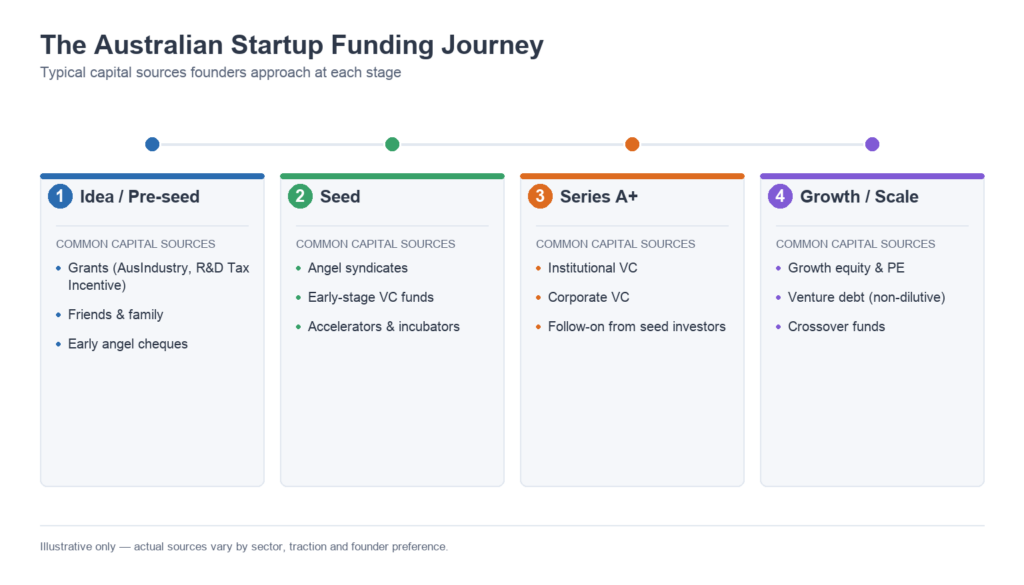
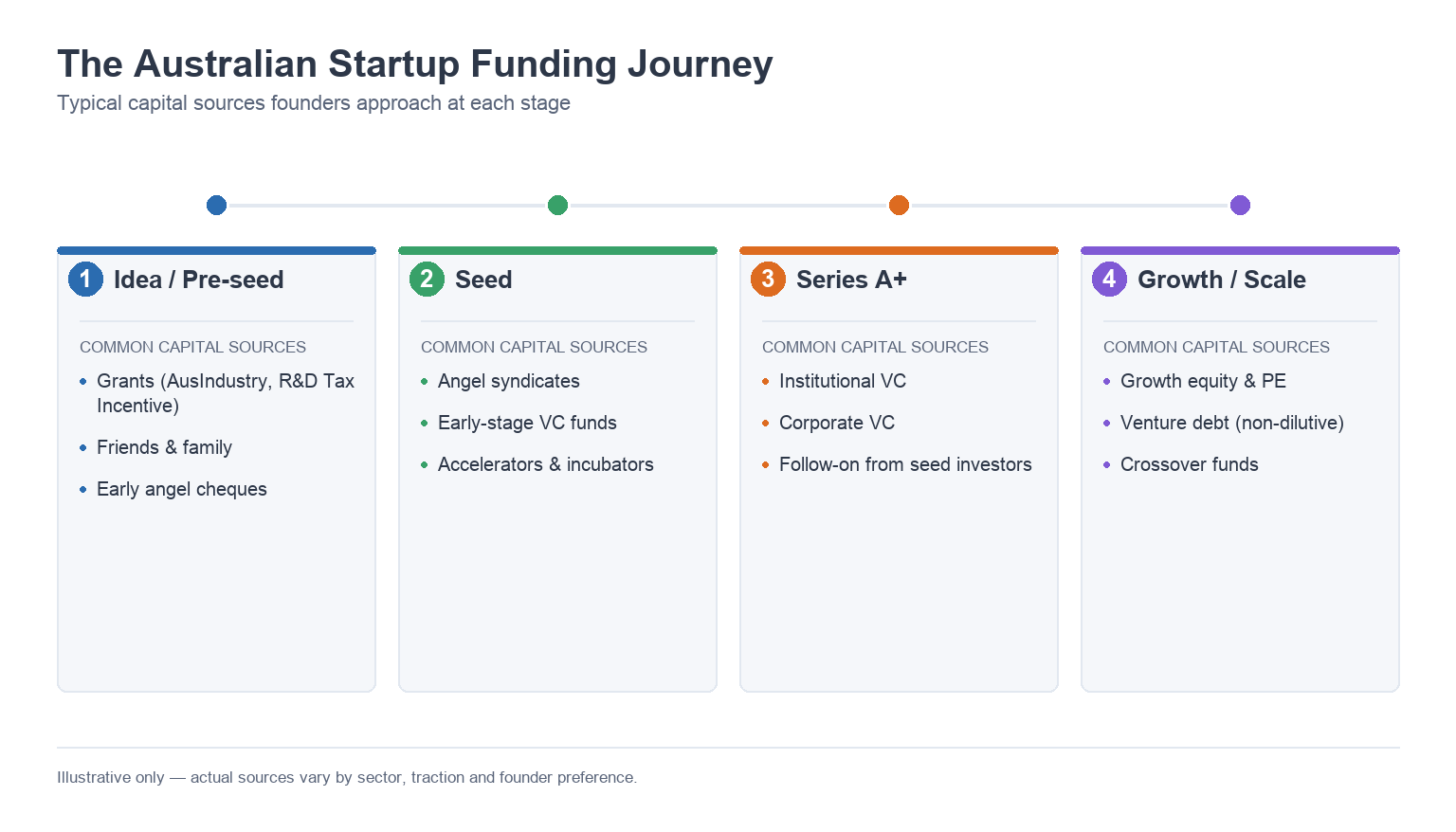
There’s no universal order, but most Australian companies follow a broadly similar pattern:
- Idea to pre-seed: Prioritise grants you’re eligible for, then friends, family and early angels for the gap.
- Seed: Angel syndicates and early-stage VC funds, often alongside an accelerator if structured guidance is more valuable than the cheque size.
- Series A and beyond: Institutional VC becomes the primary source, sometimes alongside a corporate VC where the strategic fit is genuine.
- Post-revenue growth: Venture debt is worth considering once revenue is predictable enough to service it, to extend runway between equity rounds without further dilution.
Founder perspective: Before building your investor target list, map your current stage against the table above, confirm your grant and ESIC eligibility first (it’s the only capital that doesn’t cost equity), and only then start reaching out to angels or funds whose stated mandate actually matches your sector and cheque size. A shorter, better-targeted list closes faster than a long, generic one.
Key Takeaways
- Australia’s funding landscape includes grants, angels, VC, venture debt, accelerators and corporate/PE investors, each suited to a different stage.
- Grants and R&D Tax Incentive claims are non-dilutive and worth pursuing before, or alongside, an equity raise.
- Venture debt extends runway without dilution but requires predictable revenue to service.
- ESIC status can make a company more attractive to angels and early VC by offering investors a tax offset.
- Targeting the right investor type at the right stage shortens the raise and reduces unnecessary dilution.
FAQ
What’s the difference between an angel investor and a VC fund?
An angel invests their own money and decides independently or as part of a syndicate. A VC fund invests pooled capital from institutional and other investors, with a formal investment committee and, usually, a mandate covering specific stages or sectors.
Is venture debt available to early-stage Australian startups?
Generally not to pre-revenue companies. Venture debt providers look for predictable cash flow or a recently closed equity round before extending a loan, since it still needs to be repaid.
Do grants really not require giving up equity?
Correct. Programs like the R&D Tax Incentive and AusIndustry grants are non-dilutive — founders retain full ownership, though most require compliance reporting and eligible spend to be documented.
What is ESIC status and why does it matter for fundraising?
Early Stage Innovation Company status gives eligible investors a tax offset and a potential capital gains exemption on qualifying shares. It doesn’t change how much a company can raise, but it can make an early round more attractive to angels and early-stage VC.
Should a founder approach VCs and angels at the same time?
Many seed rounds are a blend of both, closed as one round with a mix of angel and fund cheques. Running them in parallel rather than sequentially is common practice in Australia, provided terms are consistent across investors.
How many investors should a founder target in a first raise?
Quality of fit matters more than volume. A focused list of investors whose stated stage and sector mandate matches the business will convert better than a broad, untargeted list of dozens of contacts.
Conclusion
The right funding source for an Australian startup depends less on what’s fashionable and more on stage, revenue predictability and how much dilution a founder is prepared to accept. Grants and R&D incentives should usually be the first stop, angels and early VC follow once there’s a story to tell, and venture debt becomes useful once revenue can support repayment. Mapping this out before the first pitch meeting is what separates a fast, well-targeted raise from months of mismatched conversations.
For related reading, see our guides on when to approach Australian VCs, SAFE vs priced equity rounds, angel investing fundamentals, deal sourcing for angel investors and the broader Australian venture capital market.