
Angel Investing 101: How Australian Investors Can Build a Smart Portfolio
Angel investing in Australia offers a direct way to participate in the country’s growing technology sector and to support the next generation of founders. It is not a path to easy returns. Success rests on accepting the power-law nature of outcomes, building a sufficiently large portfolio, reserving capital for follow-ons, and maintaining emotional discipline when individual investments fail.

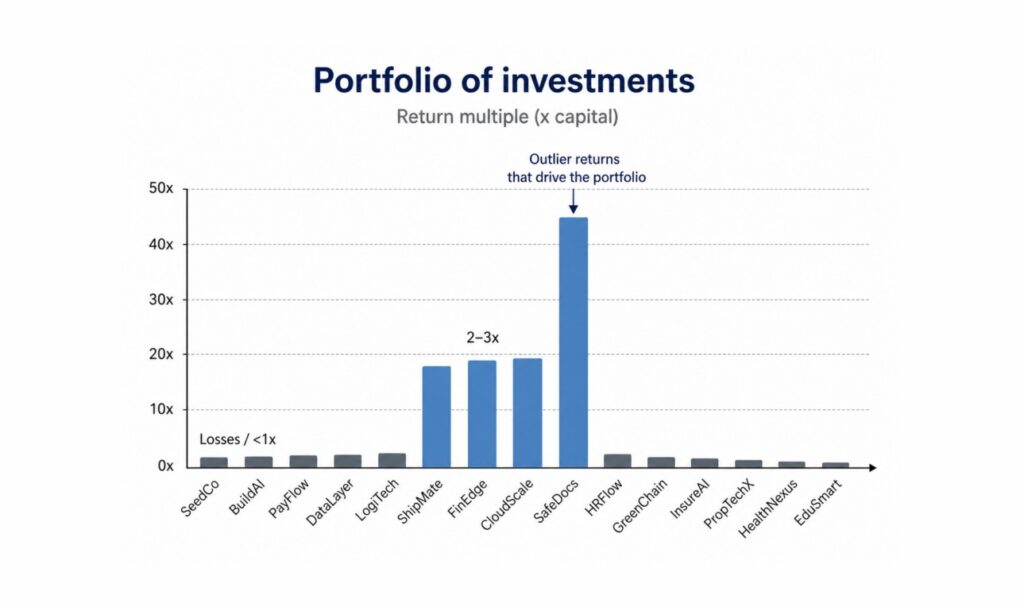
Quick answer: Angel investing means writing early cheques into seed-stage startups in exchange for equity. Returns follow a power law — most investments lose money, a few return 2–3x, and a tiny number deliver 20–100x. Success depends on building a diversified portfolio of at least 10 companies, reserving 20–30% for follow-ons, and only risking capital you can afford to lose for 8–10 years or longer.
Angel investing sits at the sharp end of Australia’s startup ecosystem. It fills the funding gap that lets founders test product-market fit before institutional venture capital arrives. For investors it offers exposure to high-growth technology companies, the chance to support ambitious founders, and the potential for outsized returns — if approached with clear eyes and disciplined portfolio construction.
This guide extracts the practical fundamentals of angel investing for the Australian and New Zealand market. It covers why people do it, how returns actually work, the importance of diversification and reserves, how to set a realistic budget, and the risks that trip up first-time angels. The focus is on actionable decisions rather than hype.
What is Angel Investing?
Angel investing is the practice of individuals (or small groups) providing capital to early-stage start-ups, usually at seed stage, in return for equity or convertible instruments. Angels typically write smaller cheques than venture funds and often bring industry experience, networks or operational support alongside the money.
In the Australian context, angels play a critical role because institutional VC remains smaller relative to GDP than in the United States or parts of Europe. Seed capital is the lifeblood that helps founders cross the early “funding gap” — the period when a company is intentionally loss-making while it builds product and finds product-market fit.
The Startup Lifecycle and Where Angels Fit
- Seed: Building product, testing the value hypothesis and aiming for product-market fit. This is where most angel cheques land.
- Series A–B: Proving a repeatable growth model — sales, pricing and customer acquisition. Larger capital is usually required.
- Growth: Scaling a proven model with significant capital.
Graduation rates drop sharply after seed: The average seed-stage company does not raise a Series A. That reality shapes everything about how angels should think about risk and portfolio size.
Why Angel Investing Matters in Australia
Australia has become one of the more capital-efficient producers of unicorns globally. Technology is now a meaningful contributor to GDP, and the pipeline of ambitious founders continues to grow. Yet the ecosystem still needs more active, informed and diverse angels.
A narrow angel base tends to produce a narrow set of funded companies. Broader participation — including more women, operators from outside traditional finance, and investors based outside Sydney and Melbourne — improves both the quality of capital and the range of problems being solved.
For the individual investor, the motivations usually combine financial and non-financial drivers: curiosity about hard problems, desire to support founders, access to deal flow, and the possibility of returns that exceed public markets. Purely financial motives are rarely enough on their own.
Benefits of Angel Investing
- Portfolio diversification: Early-stage equity behaves differently from listed shares and bonds, offering a genuine alternative asset class.
- Learning and network effects: Sitting on the cap table of multiple start-ups provides front-row insight into emerging technologies and founder skill.
- Impact and contribution: Capital and advice at seed stage can materially change a company’s trajectory.
- Potential for asymmetric upside: A small number of outlier investments can drive the majority of returns across a portfolio.
- Flexible cheque sizes: Many Australian angels successfully deploy a few thousand dollars per deal when they bring relevant expertise or strong founder relationships.
Risks and Challenges
Angel investing is one of the highest-risk, most illiquid asset classes available to individual investors. Key realities include:
- Most individual investments return less than the capital invested.
- Liquidity events (acquisition or IPO) commonly take 8–10 years or longer. Companies are staying private for extended periods.
- Emotional difficulty of watching capital disappear while founders face far greater pressure.
- Time commitment required for proper diligence, relationship building and ongoing support.
- Information asymmetry and limited secondary markets, although secondary sales are becoming more common.
If the sole objective is financial return, a diversified index fund is the superior choice for the large majority of people. Successful angels tend to be those who combine genuine curiosity or domain advantage with disciplined portfolio construction.
How Returns Actually Work: The Power Law
Venture and angel returns do not follow a normal distribution. They follow a power law. In any random collection of early-stage investments:
- Most will lose money or return close to zero.
- A smaller number may return 2–3x.
- A very small number may return 20x, 50x or 100x.
The mathematical implication is straightforward: the only reliable way to capture the upside is to hold enough positions that the probability of owning one or two outliers becomes meaningful. A portfolio of one or two investments is closer to gambling than investing.
A practical rule of thumb used by experienced Australian angels is to aim for at least 10 investments (often more) deployed over several years. Concentration of additional capital into the clear winners (via reserves) then amplifies the effect of the power law.
| Portfolio Approach | Typical Outcome | Key Risk |
|---|---|---|
| 1–3 investments | High chance of overall loss | Single-company failure dominates results |
| 5–10 investments | Possible break-even to modest gain | Still dependent on one or two winners |
| 10+ investments + reserves | Best chance of capturing power-law returns | Requires more capital and time |
Best Practices for Building an Angel Portfolio
1. Set a Realistic Multi-Year Budget
Decide the total amount you are prepared to deploy over 3–5 years. You do not need the full sum sitting in cash today — only a credible plan to have it available as deals arise. Remember that meaningful liquidity is unlikely inside a decade.
2. Reserve 20–30% for Follow-On Investments
The strongest companies will raise later rounds. Holding capital in reserve allows you to increase ownership in the winners rather than watching your stake dilute. This is one of the highest-leverage decisions an angel can make.
3. Calculate and Stick to a Standard Cheque Size
Take the non-reserve portion of your budget and divide by the target number of companies. Once you have a consistent cheque size, protect it. The temptation to “bet the house” on a particularly compelling founder is strong; history shows most investors cannot reliably identify the future outliers at seed stage.
4. Accept That Small Cheques Are Valid
Australian angels regularly invest a few thousand dollars when they bring domain expertise, introductions or hands-on help. Larger cheques are not a prerequisite for meaningful participation.
5. Manage Emotions and Loss Aversion
You will lose money on a material percentage of investments. That outcome is normal, not a personal failure. The founder’s stress in a struggling company is almost always greater than the investor’s.
Investor perspective: Treat angel investing as a multi-year programme rather than a series of one-off bets. The goal is not to avoid losses — that is impossible — but to construct a portfolio in which the winners more than compensate for the inevitable zeros.
Founder perspective: Angels who understand the power-law reality and maintain reserves are usually better long-term partners. They are less likely to panic at the first sign of difficulty and more likely to support follow-on rounds when the company is working.
Key Takeaways
- Angel investing is high-risk and illiquid. Only use capital you can afford to lose for a decade or more.
- Returns follow a power law. Diversification across 10+ companies is the primary risk-management tool.
- Reserve 20–30% of your total budget for follow-on investments in winners.
- Set a consistent cheque size and stick to it. Avoid the urge to concentrate too early.
- Australia’s ecosystem needs more diverse, informed angels. The opportunity and the need are both real.
- If pure financial return is the only goal, a balanced index fund remains the superior choice for most people.
Actionable Checklist for Prospective Angels
- Decide the total capital you can allocate over 3–5 years without affecting lifestyle or other goals.
- Ring-fence 20–30% of that amount as follow-on reserves.
- Choose a target portfolio size (minimum 10 companies) and calculate a standard initial cheque.
- Write down your non-financial reasons for investing (curiosity, domain knowledge, desire to support founders).
- Identify sources of deal flow you can access consistently (networks, programs, syndicates, accelerators).
- Commit to a multi-year time horizon and accept that liquidity will be slow.
- Seek independent financial, legal and tax advice before writing any cheques.
Frequently Asked Questions
How much money do I need to start angel investing in Australia?
There is no fixed minimum. Many angels begin with cheques of a few thousand dollars, especially when they bring skills or networks. Building a properly diversified portfolio of 10+ companies plus reserves typically requires a multi-year commitment in the tens or hundreds of thousands of dollars, depending on cheque size.
How many investments should an angel portfolio contain?
A practical minimum is 10 companies, with many experienced angels targeting more. Fewer than five leaves the portfolio highly dependent on luck. Investments are usually made over several years rather than all at once.
What are reserves and why do they matter?
Reserves are capital deliberately held back to invest in later rounds of the strongest companies in your portfolio. Allocating 20–30% of total budget to reserves allows you to increase ownership in winners rather than being diluted.
How long does it take to see returns from angel investments?
Meaningful liquidity events commonly take 8–10 years or longer. Partial liquidity via secondary sales is becoming more available but should not be relied upon as a primary exit path.
Is angel investing suitable if I only care about financial returns?
For pure financial return, a diversified index fund is the better choice for the large majority of people. Angel investing works best when investors also value the learning, network and contribution aspects.
Are SAFEs commonly used by Australian angels?
SAFE notes are less standardised and less common in Australia than in the United States. Many local deals still use convertible notes or priced equity. Always obtain local legal advice on the specific instrument being offered.
Conclusion
Angel investing in Australia offers a direct way to participate in the country’s growing technology sector and to support the next generation of founders. It is not a path to easy returns. Success rests on accepting the power-law nature of outcomes, building a sufficiently large portfolio, reserving capital for follow-ons, and maintaining emotional discipline when individual investments fail.
The Australian ecosystem benefits when more informed, diverse and patient capital arrives at the seed stage. For those who approach the asset class with clear expectations and a multi-year plan, angel investing can be both intellectually rewarding and, over a long enough horizon, financially meaningful.
For related reading, see our guides on deal sourcing for angel investors, the Australian venture capital market, capital raising and dilution and SAFE notes vs priced equity rounds.
This article provides general information only and does not constitute financial, legal or tax advice. Individual circumstances vary. Always seek independent professional advice before making investment decisions.