
How Pre-Seed Venture Funds Are Structured: Fund Economics
How Australian pre-seed venture funds are typically structured, including portfolio size, target returns and fund life.

Introduction
Behind every pre-seed cheque sits a fund structure that shapes how, and how often, that fund can write cheques. For investors considering an allocation to Australian pre-seed venture — whether as a direct LP, through a syndicate, or evaluating a fund manager’s track record — understanding the basic economics of a pre-seed fund is essential context that a pitch deck alone won’t provide.
This guide explains how pre-seed venture funds are typically structured, what portfolio construction and return targets look like, and how funds evolve from informal syndicates into institutional vehicles.
Quick answer: A typical Australian pre-seed fund targets a portfolio of roughly 20-30 companies, aiming for a 3-5x return multiple over a ten-year fund life, reflecting the reality that a small number of outlier outcomes drive the bulk of returns. Many funds also offer eligible investors ESVCLP tax benefits and some evolve from deal-by-deal syndicates into formal, larger fund structures over time.
What Does Pre-Seed Fund Structure Actually Involve?
Pre-seed fund structure covers how a fund raises capital from LPs, how many companies it plans to back, what return multiple it targets, and what legal vehicle (such as an ESVCLP) it uses. These structural choices shape everything from tax treatment for investors to how aggressively a fund can pursue follow-on investments in its best-performing companies.
Why Fund Structure Matters to Investors
Two funds targeting the same sector and stage can have very different risk and return profiles depending purely on structure — portfolio size, reserve strategy for follow-on rounds, and fund life all affect expected outcomes independently of deal-picking skill. Understanding these mechanics helps investors evaluate a fund manager’s approach, not just their pitch.
- Portfolio size affects how much a single outlier company can move overall fund returns.
- A fund’s reserve strategy for follow-on investment shapes how much of the eventual winners’ upside it actually captures.
- Legal structure (such as ESVCLP status) determines available tax benefits for eligible investors.
- A ten-year-plus fund life is standard in venture, reflecting how long it takes portfolio companies to reach a meaningful exit.
Benefits of Understanding Fund Economics as an Investor
- Better manager evaluation — understanding portfolio construction helps assess whether a fund’s stated strategy matches its structure.
- Realistic return expectations — knowing that a small number of outcomes typically drive most returns tempers expectations around any single investment.
- Clearer tax planning — understanding available structures like ESVCLPs helps investors factor in the tax treatment of a given fund.
- More informed diversification — understanding typical portfolio sizes helps investors judge how much diversification a single fund allocation actually provides.
Risks and Challenges in Pre-Seed Fund Economics
- Power law concentration. Most of a fund’s return typically comes from a small number of its portfolio companies, meaning fund-level returns can look very different from the “average” deal.
- Limited reserve capital. Funds that don’t reserve enough capital for follow-on rounds risk being diluted out of their best-performing companies over time.
- Long illiquidity. A typical ten-year-plus fund life means capital committed to pre-seed vehicles is tied up for a substantial period.
- Track record limitations. Newer funds or those on their first or second vehicle have a shorter history to evaluate than more established managers.
Typical Pre-Seed Fund Structure at a Glance
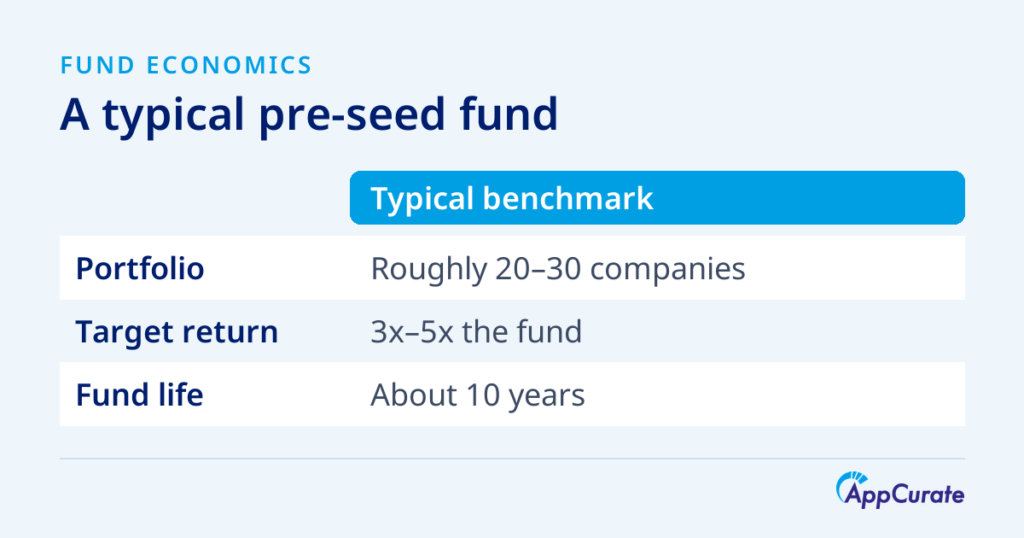
The chart below summarises common benchmarks for how an Australian pre-seed fund is typically structured.
| Structural Factor | Typical Benchmark | Why It Matters |
|---|---|---|
| Portfolio size | Roughly 20–30 companies | Balances diversification against meaningful ownership per deal |
| Target return multiple | 3x–5x fund-level MOIC | Reflects the venture power-law return profile |
| Fund life | ~10 years | Time needed for portfolio companies to reach exit |
| Legal structure | Often ESVCLP for eligible funds | Offers tax benefits to qualifying investors |
Best Practices for Evaluating a Pre-Seed Fund’s Structure
- Ask a fund manager directly about their reserve strategy for follow-on investment, not just their initial cheque size.
- Check whether the fund’s target portfolio size is consistent with its stated stage focus and sector breadth.
- Confirm the fund’s legal structure and whether it offers ESVCLP or similar tax-advantaged status for eligible investors.
- Look at how a manager’s fund has evolved over multiple vintages, if applicable — a shift from informal syndicate to institutional fund structure can signal maturing process and track record.
- Treat a single fund’s return multiple with appropriate scepticism until enough of its portfolio has reached a real exit outcome.
- Ask how a fund’s portfolio construction has changed between vintages, if it has raised more than one fund, since this often reveals lessons learned about sizing and reserves.
- Where a fund quotes a syndicate-level track record (such as MOIC across a portfolio of deals), clarify whether that figure includes unrealised, marked-up positions or only realised exits.
It’s also worth remembering that a fund’s earliest vintages are the hardest to judge fairly, since venture outcomes take years to materialise. A manager on their second or third fund with a consistent, disciplined structure across vintages is generally easier to evaluate than one still on a first fund with few, if any, realised outcomes.
Investor Perspective
Investor perspective: Fund structure is a better predictor of a manager’s discipline than any individual deal in their portfolio. A manager who can clearly explain their portfolio construction logic, reserve strategy and target return rationale is demonstrating the same rigour they’ll apply when deciding whether to double down on a winner three years into the fund’s life.
Key Takeaways
- A typical Australian pre-seed fund targets a portfolio of roughly 20–30 companies and a 3x–5x return multiple.
- Fund life is commonly around ten years, reflecting how long venture outcomes take to materialise.
- Reserve strategy for follow-on investment materially affects how much of a winner’s upside a fund actually captures.
- ESVCLP and similar structures can offer tax benefits to eligible investors, depending on the fund’s legal setup.
- Some funds evolve from informal, deal-by-deal syndicates into larger, more structured institutional vehicles over time.
FAQ
How many companies does a typical pre-seed fund invest in?
Many target a portfolio of roughly 20 to 30 companies, balancing diversification against meaningful ownership in each deal.
What return multiple do pre-seed funds typically target?
A common target range is 3x to 5x the fund’s committed capital, reflecting the concentrated, power-law nature of venture returns.
How long is capital typically locked up in a pre-seed fund?
Fund life is commonly around ten years or more, reflecting the time needed for portfolio companies to reach a meaningful exit.
What is an ESVCLP and why does it matter to investors?
An Early Stage Venture Capital Limited Partnership (ESVCLP) is a fund structure that can offer eligible investors tax benefits on qualifying gains, in addition to standard flow-through tax treatment.
Why does a fund’s reserve strategy matter?
Reserves set aside for follow-on investment determine how much a fund can continue backing its best-performing companies in later rounds, protecting its ownership from dilution.
Do all pre-seed funds start as informal syndicates?
No, but some do evolve that way — beginning as a group of investors backing deals informally before transitioning into a more formal, larger fund structure over time.
Conclusion
Understanding pre-seed fund economics — portfolio size, target returns, reserve strategy and legal structure — gives investors a far more useful lens on manager quality than any single pitch or deal alone. Whether evaluating a fund for a direct LP commitment or backing a manager through a syndicate, these structural fundamentals are what actually shape long-term outcomes.
For related reading, see our guides on how fund managers and syndicates raise capital, lead vs co-invest VC models, how startup investor matching works and angel investing fundamentals.