
What is an ESVCLP? Tax Benefits for Australian Investors
What an ESVCLP fund is, the tax exemption it can offer eligible Australian investors, and what to check before investing in one.

Introduction
An ESVCLP fund in Australia offers something few other venture structures can: a genuine tax exemption on gains from eligible early-stage investments, rather than just favourable flow-through treatment. For investors weighing an allocation to Australian venture capital, understanding how this structure actually works — and its trade-offs — is essential before committing capital.
This guide explains what an ESVCLP is, the tax treatment it offers eligible investors and what to check before investing in one.
Quick answer: An ESVCLP (Early Stage Venture Capital Limited Partnership) is an Australian fund structure that lets eligible wholesale and sophisticated investors receive tax-exempt treatment on their share of gains from qualifying early-stage venture investments, alongside standard flow-through tax treatment. In exchange, the fund must meet registration and ongoing compliance requirements around its investment focus and structure.
What is an ESVCLP?
An ESVCLP is a limited partnership structure registered under Australian venture capital legislation, designed specifically to channel capital into early-stage, high-growth companies. Investors (limited partners) commit capital to the fund, which then makes venture investments on their behalf, with the tax treatment on qualifying gains passed through to investors largely tax-free.
Why the ESVCLP Structure Matters for Investors
Standard venture fund structures already offer flow-through tax treatment, meaning income and gains are taxed at the investor level rather than the fund level. An ESVCLP goes further for eligible investments, offering a genuine exemption on qualifying gains rather than just avoiding double taxation. This materially changes the after-tax return profile for investors who hold through to a successful exit.
- Gains on qualifying investments can be exempt from tax for eligible investors, not just deferred.
- The structure is specifically designed to encourage capital into early-stage, high-growth ventures.
- Registration and compliance requirements exist to ensure the fund’s investments genuinely fit the early-stage venture criteria the concession is designed for.
- Some fund managers have shown they can raise a new ESVCLP vehicle quickly when investor demand is strong — one Australian early-stage fund reportedly closed a $32 million-plus ESVCLP raise in under a month.
Benefits of Investing Through an ESVCLP
- Potential tax exemption on qualifying gains, improving after-tax returns compared to a standard structure.
- Access to a diversified portfolio of early-stage companies rather than a single direct investment.
- Professional management and diligence applied across every investment in the fund.
- Exposure to co-investment networks; ESVCLP-backed rounds are often syndicated alongside other domestic and international venture funds.
Risks and Challenges to Understand
- Eligibility requirements apply. ESVCLPs are generally only available to wholesale or sophisticated investors, not retail investors.
- Long lock-up periods. Venture fund structures, including ESVCLPs, commonly commit investor capital for a decade or more.
- Compliance-dependent benefits. The tax treatment depends on the fund maintaining its registration and meeting ongoing eligibility criteria; a compliance failure can affect the concession.
- Concentration in early-stage risk. The underlying investments are inherently high-risk, early-stage ventures, regardless of the tax treatment wrapped around them.
ESVCLP vs a Standard Venture Fund Structure
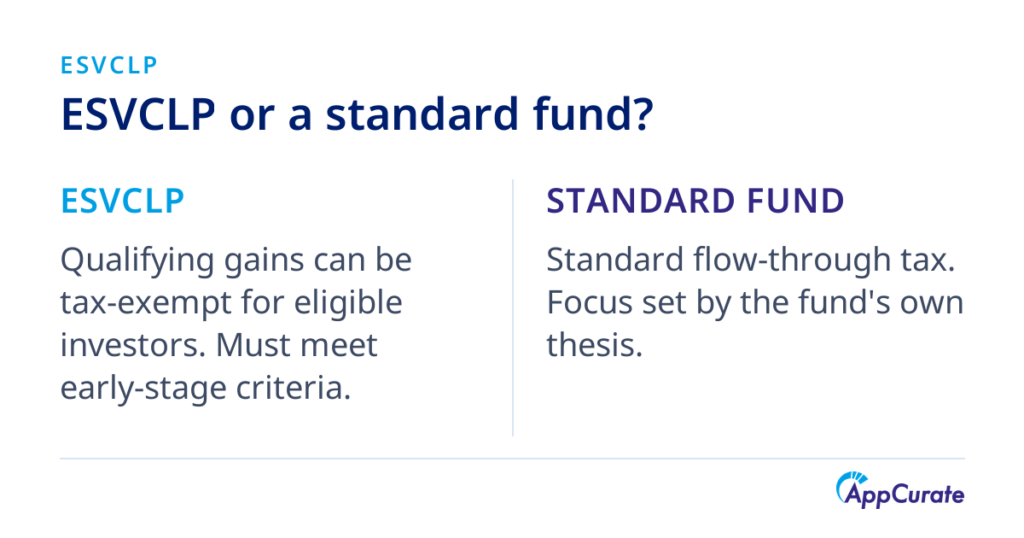
The chart below summarises the key differences investors should understand.
| Factor | ESVCLP | Standard Venture Fund (Unit Trust) |
|---|---|---|
| Tax treatment on qualifying gains | Can be exempt for eligible investors | Standard flow-through taxation applies |
| Eligible investors | Wholesale and sophisticated investors | Varies by fund, often similar restrictions |
| Investment focus | Must meet early-stage venture criteria | Flexible, set by the fund’s own thesis |
| Compliance burden | Registration plus ongoing eligibility requirements | Standard trust and AFSL-related compliance |
Best Practices Before Investing in an ESVCLP
- Confirm your own eligibility as a wholesale or sophisticated investor with your accountant before assuming the structure applies to you.
- Ask the fund manager directly how they maintain ongoing ESVCLP registration and compliance, not just how the structure was set up initially.
- Understand the fund’s investment thesis and stage focus independently of the tax treatment; a good structure doesn’t compensate for a weak strategy.
- Factor in the long lock-up period when sizing an allocation relative to your broader portfolio and liquidity needs.
- Get independent tax advice specific to your circumstances, since the exemption’s practical value depends on your own tax position.
- Ask how the fund’s portfolio is diversified across sectors and stages, since concentration in any single theme increases the risk that the tax benefit is riding on a narrower set of outcomes.
- Review who the fund typically co-invests alongside; syndication with well-regarded domestic and international VCs can be a useful signal of deal quality, though it’s not a guarantee.
It’s also worth asking how quickly a manager has been able to raise previous vehicles. A fund that closes a raise quickly with support from existing founders, investors and family offices can indicate strong reputation and repeat investor confidence, though speed alone shouldn’t substitute for your own diligence on the manager’s strategy and track record.
Investor Perspective
Investor perspective: The ESVCLP tax treatment is a genuine enhancement to after-tax returns, but it shouldn’t be the primary reason to back a fund. Evaluate the manager’s track record, portfolio construction and access to quality dealflow first — the tax structure is a multiplier on a good investment decision, not a substitute for one.
Key Takeaways
- An ESVCLP offers eligible investors potential tax exemption on gains from qualifying early-stage venture investments.
- Access is generally limited to wholesale and sophisticated investors, not retail investors.
- The tax benefit depends on the fund maintaining its registration and meeting ongoing compliance requirements.
- Capital is typically locked up for a decade or more, consistent with standard venture fund structures.
- Manager quality and investment thesis matter more than the tax wrapper alone when evaluating a fund.
FAQ
What does ESVCLP stand for?
Early Stage Venture Capital Limited Partnership, a registered Australian fund structure designed to channel capital into early-stage, high-growth companies.
Who can invest in an ESVCLP?
Access is generally limited to wholesale and sophisticated investors, consistent with most Australian early-stage venture fund structures.
Is an ESVCLP completely tax-free for investors?
Gains on qualifying investments can be exempt from tax for eligible investors, but the exact treatment depends on individual circumstances and the fund maintaining its compliance requirements, so independent tax advice is important.
How long is capital typically locked up in an ESVCLP?
Consistent with venture capital generally, capital is commonly committed for a decade or more, reflecting the time needed for portfolio companies to reach an exit.
Do all Australian venture funds use the ESVCLP structure?
No. Many funds use alternative structures such as a VCLP or unit trust, depending on their investor base, fund size and investment thesis.
What happens if a fund loses its ESVCLP registration?
Compliance failures can affect the availability of the tax concession, which is why it’s worth asking a fund manager directly how they maintain ongoing eligibility.
Conclusion
An ESVCLP fund gives eligible Australian investors a genuine tax advantage on qualifying early-stage venture gains, on top of the diversification and professional management a fund structure already provides. That advantage is real, but it works best as a multiplier on a strong manager and thesis, not a reason to overlook the fundamentals of manager quality, portfolio construction and long lock-up periods that apply to venture investing generally.
For related reading, see our guides on how pre-seed venture funds are structured, how fund managers and syndicates raise capital, how startup investor matching works and angel investing fundamentals.