
Lead vs Co-Invest: How VC Models Shape Your Capital Raise
The difference between a lead investor and a co-investment fund and how understanding both helps you sequence a startup capital raise.

Introduction
Not every fund that writes a cheque wants to lead your round. A meaningful share of the Australian VC market now operates as co-investors — happy to fold into a round someone else is leading, drawing on a wide network of other investors rather than insisting on setting every term themselves. Understanding this distinction changes how founders should sequence conversations when they raise capital for a startup.
This guide explains the difference between lead investors and co-investment or syndicate-style funds, and what it means for how you build your round.
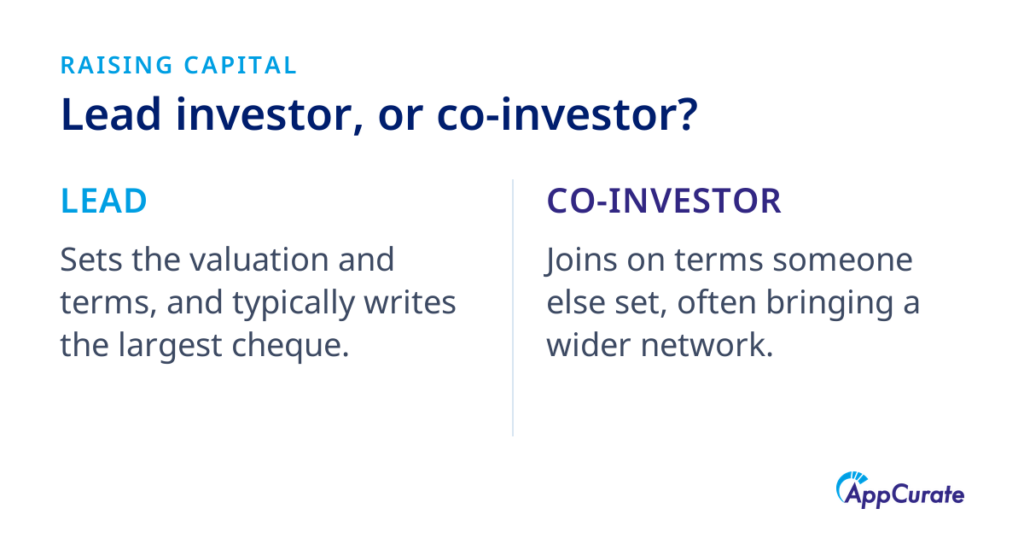
Quick answer: A lead investor sets the terms of a round and typically writes the largest cheque; a co-investment fund joins a round on terms someone else has set, often bringing a wider network of additional investors with them. Founders usually need at least one lead before co-investors will commit, but co-investors can help fill out a round quickly once terms are agreed.
What’s the Difference Between a Lead and a Co-Investor?
A lead investor negotiates and sets the valuation and key terms for a round, usually writing its largest single cheque and often taking a board seat. A co-investor joins on those already-agreed terms, contributing capital and sometimes a network of additional investors, without needing to negotiate the deal itself.
Why This Distinction Matters When Raising Capital
Most co-investment funds won’t commit until a lead has set terms, which means founders usually need to secure a lead investor before a syndicate-style fund will meaningfully engage. Understanding this sequencing avoids wasted time pitching co-investors before a round has real terms to join.
- A lead investor’s terms become the reference point every co-investor evaluates against.
- Co-investment funds can move faster once terms are set, since they’re not renegotiating the deal.
- A fund willing to co-invest, rather than insisting on leading, can be more flexible about cheque size and timing.
- Access to a co-investor’s broader network can help fill out a round beyond what a single lead provides.
Benefits of the Co-Investment Model for Founders
- Faster round completion — co-investors joining agreed terms can commit more quickly than a fund starting negotiations from scratch.
- Wider investor base — syndicate-style funds often bring a large network of individual investors who can each contribute smaller amounts.
- More flexible mandates — a fund without a fixed insistence on leading can adapt to what a round actually needs.
- Diversified support — a broader group of co-investors adds more perspectives and introductions than a single lead alone.
Risks and Challenges to Understand
- Co-investors won’t set your terms for you. Founders still need a credible lead willing to negotiate valuation and key terms.
- Coordination overhead. A round with many smaller co-investors can mean more individual relationships to manage post-close, particularly around updates and communication.
- Uneven engagement. Some co-investors are highly active; others are largely passive once capital is committed, which is worth understanding before accepting a cheque.
- Assuming co-investment means less scrutiny. Co-investors still run their own diligence, even when they’re not setting the deal’s terms.
Lead Investor vs Co-Investment Fund
The table below summarises the key differences founders should understand before approaching either type of investor.
| Factor | Lead Investor | Co-Investment Fund |
|---|---|---|
| Sets valuation and terms | Yes | No, joins agreed terms |
| Typical cheque role | Largest single cheque | Variable, often smaller per investor |
| Board involvement | Often takes a board seat | Usually observer or no formal seat |
| Network reach | Own portfolio and contacts | Often a wider syndicate or community of investors |
| When to approach | Early, before terms are set | Once a lead and terms exist |
Best Practices for Building a Round With Both
- Secure a credible lead before spending significant time pitching co-investment funds.
- Ask any prospective investor directly whether they lead, co-invest, or do both, so you know how to sequence the conversation.
- Once terms are set, share them clearly and quickly with co-investment funds to take advantage of their faster decision process.
- Clarify expected involvement upfront — board seat, observer rights, or purely passive — so post-close expectations are aligned.
- Build a simple system for keeping a larger group of co-investors updated without it becoming a significant time cost.
- Confirm whether a co-investor expects pro-rata rights in future rounds before you close, so there are no surprises when you raise again.
- Where a fund is genuinely flexible on leading or co-investing, be upfront about where you are in the process, so they can decide which role makes sense for them.
It’s also worth asking a prospective lead directly how they typically work with co-investors on a round, since some leads are happy to make introductions to their own network of syndicate partners, which can meaningfully speed up filling out the rest of your raise.
Founder Perspective
Founder perspective: Don’t write off a fund because it tells you upfront it prefers to co-invest rather than lead — that flexibility can be exactly what helps you fill out a round quickly once you have terms. The mistake is pitching a committed co-investor as if they’re going to set your valuation for you; get a lead in place first, then bring the co-investors in.
Key Takeaways
- A lead investor sets a round’s terms; a co-investment fund joins those terms once they’re agreed.
- Most co-investors won’t meaningfully engage until a lead is in place, so sequence your outreach accordingly.
- Co-investment and syndicate-style funds can move faster and bring a wider investor network once terms exist.
- Clarify expected involvement (board seat, observer, passive) with every investor before closing.
- A flexible fund willing to co-invest rather than insist on leading can be a genuine asset in filling out a round.
FAQ
What is a lead investor in a startup capital raise?
The investor who negotiates and sets the valuation and key terms of a round, typically contributing the largest single cheque and often taking a board seat.
What does it mean for a fund to “co-invest”?
It means the fund joins a round on terms already negotiated by a lead investor, rather than setting the deal’s terms itself.
Do I need a lead investor before approaching co-investment funds?
Generally yes. Most co-investment funds wait for a credible lead and agreed terms before committing meaningfully.
Are co-investment funds less rigorous in their diligence?
Not necessarily. They still typically run their own diligence process, even though they’re not negotiating the round’s terms.
Can a fund both lead and co-invest depending on the deal?
Yes. Many funds are flexible and will lead when the opportunity calls for it, or co-invest when another fund is better positioned to lead.
Does a syndicate-style fund add more than just capital?
Often, yes. Many bring a wider network of individual investors who can offer introductions, expertise and follow-on support beyond the initial cheque.
Conclusion
Knowing the difference between a lead investor and a co-investment fund helps founders sequence their raise correctly — securing terms with a lead first, then using co-investors to fill out the round quickly and bring additional networks to the table. Both play a genuine role in a well-constructed capital raise, provided founders approach each in the right order.
For related reading, see our guides on how to find and approach investors, how fund managers and syndicates raise capital, types of startup investors in Australia and when to approach Australian VCs.