
Thematic vs Generalist Pre-Seed Investors: Which Fits You?
The difference between thematic and generalist pre-seed investors in Australia, and how to work out which is the better fit.

Introduction
Not every pre-seed fund invests the same way. Some are deliberately generalist, backing outlier founders across any sector. Others are highly thematic — built around a specific technology shift or industry conviction — and invest almost exclusively within that lens. Knowing which type of fund you’re pitching changes what actually gets you a “yes.”
This guide explains the difference between thematic and generalist pre-seed investors in Australia, and how to work out which is the better fit for your startup.
Quick answer: Generalist pre-seed funds back strong founders across any sector, evaluating each opportunity on its own merits. Thematic funds invest through a specific lens — such as a belief that a particular technology will reshape how work gets done — and expect founders to speak directly to that thesis. A specialised startup often fares better with a thematic fund that already shares its worldview.
What’s the Difference Between Thematic and Generalist Investors?
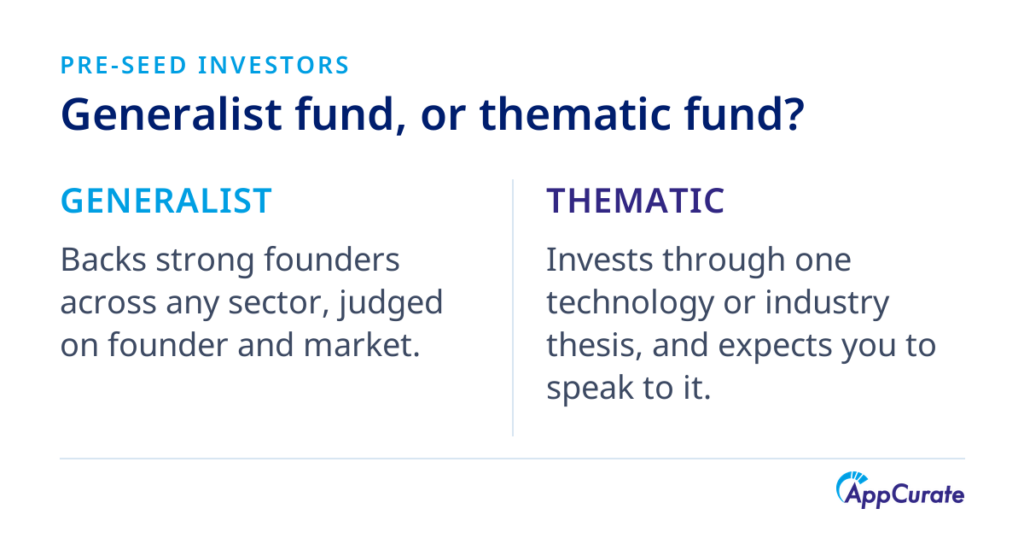
A generalist pre-seed fund evaluates founders and opportunities individually, without a fixed sector lens, prioritising founder quality and market size above thematic fit. A thematic fund invests through a specific, often deeply researched conviction about where an industry or technology is heading, and expects a startup’s story to connect directly to that thesis.
Why This Distinction Matters When You Pitch
A founder pitching a thematic fund without understanding its specific thesis is effectively pitching blind — even a strong business can be rejected simply for not connecting to what the fund believes. Conversely, a founder with a highly specialised, technical business may get a much sharper, more useful conversation from a fund whose partners already understand the space deeply.
- Thematic funds bring deep domain expertise that a generalist fund may lack.
- Generalist funds bring broader pattern-matching across sectors, useful for businesses that don’t fit a neat category.
- A thematic fund’s team can often provide more specific, technical guidance post-investment within its area of focus.
- Highly thematic and hands-on funds sometimes support a smaller number of companies more intensively, rather than spreading across a large portfolio.
Benefits of Matching Fund Type to Startup Type
- More relevant feedback — a thematic investor can often stress-test a specialised idea more rigorously than a generalist.
- Faster conviction — a fund already aligned with your sector thesis may move faster than one that needs convincing of the category itself.
- Stronger network fit — thematic funds often bring introductions specifically relevant to their focus area’s ecosystem.
- Reduced wasted pitches — understanding fund type upfront avoids pitching a highly specialised business to a fund with no context for the space.
Risks and Challenges to Watch For
- Assuming thematic means easier. A fund with deep conviction in your sector will often scrutinise the specifics more closely, not less.
- Missing thesis alignment. A technically strong business that doesn’t fit a thematic fund’s current worldview can be turned down regardless of quality.
- Over-narrowing your search. Founders in emerging or cross-category spaces may fit better with a generalist fund than forcing a fit with a thematic one.
- Underestimating generalist pattern-matching. Generalist funds see a wide range of businesses and can sometimes spot risks or opportunities a narrowly focused thematic fund might miss.
Thematic vs Generalist Pre-Seed Investors
The table below summarises the key differences founders should weigh before choosing who to approach.
| Factor | Generalist Fund | Thematic Fund |
|---|---|---|
| Sector focus | None; evaluates across categories | Specific technology or industry thesis |
| Evaluation style | Founder and market-led | Thesis-fit led, then founder and market |
| Domain expertise | Broad, pattern-matching across sectors | Deep within its specific focus area |
| Best fit for | Cross-category or hard-to-classify startups | Startups squarely inside the fund’s thesis |
Best Practices for Choosing Between the Two
- Research a thematic fund’s specific published thesis before pitching, not just its general sector label.
- If your business sits across categories or doesn’t fit a neat theme, prioritise generalist funds that evaluate on founder and market merit.
- For a highly specialised or technical business, seek out thematic funds whose team has genuine domain depth, not just sector interest.
- Ask a thematic fund directly how their thesis has evolved recently, since some update it more often than their public materials suggest.
- Consider approaching both types in parallel rather than assuming only one path applies to your business.
- Prepare different framing for each type of fund: lead with thesis alignment for a thematic investor, and lead with founder story and market size for a generalist.
- Where a thematic fund passes, ask whether the issue was thesis fit or the specific business, since the two require very different next steps.
It’s worth noting that the line between the two isn’t always rigid in practice. Some generalist funds develop informal, evolving points of view about which sectors excite them most, even without a formally published thesis, so it’s worth asking directly about current interests during any early conversation rather than relying purely on public positioning.
Founder Perspective
Founder perspective: If your startup is built squarely around a specific technology shift, find the thematic funds that already believe in that shift before spending time convincing generalists of the category itself. The pitch gets much easier when the investor already shares your view of where the world is heading — your job becomes proving you’re the team to execute on it.
Key Takeaways
- Generalist funds evaluate founders and markets broadly; thematic funds invest through a specific, researched conviction.
- A specialised, technical startup often gets more useful engagement from a thematic fund aligned with its space.
- Cross-category or hard-to-classify startups may be a better fit for generalist funds.
- Research a thematic fund’s actual current thesis before pitching, since it can evolve faster than public materials suggest.
- Approaching both fund types in parallel is a reasonable strategy rather than assuming only one applies.
FAQ
What is a thematic venture capital fund?
A fund that invests through a specific, researched conviction about where an industry or technology is heading, rather than evaluating opportunities across all sectors equally.
Is it harder to get funded by a thematic investor?
Not necessarily harder, but different — the pitch needs to connect clearly to the fund’s specific thesis, and scrutiny within that thesis can be intense.
Should a generalist startup avoid thematic funds entirely?
Not entirely, but it’s usually more efficient to prioritise generalist funds if your business doesn’t fit any thematic fund’s current focus.
Do thematic funds only invest in one narrow area?
Typically yes, though the “theme” can be broad, such as a belief in a particular technology reshaping many industries rather than one single product category.
Can a fund be both generalist and thematic?
Some funds are sector-agnostic but hold specific views on founder types or market conditions, which blurs the line, but most funds lean clearly toward one approach or the other.
How do I find a thematic fund’s actual current thesis?
Check the fund’s own website and recent public commentary or portfolio announcements, which usually reveal current focus more accurately than a static “about” page.
Conclusion
Matching your pitch to the right type of pre-seed investor — thematic or generalist — is one of the simplest ways to improve your odds without changing anything about your underlying business. A highly specialised startup usually benefits from finding a thematic fund that already shares its worldview, while cross-category businesses are often better served by a generalist fund evaluating on founder and market merit alone.
For related reading, see our guides on how to match your startup to a VC thesis, types of startup investors in Australia, non-dilutive MVP accelerators for deep tech founders and how to find and approach investors.