
What Pre-Seed Investors Look for in Founders
What generalist pre-seed investors evaluate from founder quality to market size, before writing a first cheque.

Introduction
Founders who secure pre-seed funding tend to share a specific profile that generalist pre-seed funds look for again and again. Understanding these criteria before you pitch — rather than after a string of “no”s — saves months of misdirected outreach.
This guide breaks down what generalist pre-seed investors evaluate, using the recurring criteria that show up across Australian early-stage funds.
Quick answer: Generalist pre-seed investors in Australia look for founders with genuine hustle and a big vision, a product solving a real problem in a large market, and a team capable of attracting talent and capital as the company grows. Most are comfortable backing pre-revenue and even pre-product companies and are flexible on valuation in exchange for the right founder.
What Do Generalist Pre-Seed Investors Actually Invest In?
Generalist pre-seed funds back founders across sectors rather than specialising in one industry, using a consistent set of criteria — founder quality, market size, product differentiation — to evaluate wildly different businesses. Most write first cheques well before a company has meaningful revenue or, in some cases, even a finished product.
This is a deliberate design choice, not a lack of focus. By staying sector-agnostic, these funds can back the strongest founder in any category rather than being limited to whichever industries happen to be fashionable at the time they raised their own fund.
Why Understanding Investor Criteria Matters Early
Founders often assume pre-seed is simply “too early to be judged on anything specific,” but generalist funds apply consistent criteria even at this stage. Knowing what they’re actually assessing helps founders build a pitch and a business around the right evidence, rather than guessing what investors want to hear.
- Pre-seed funds evaluate founders as much as (or more than) the current product.
- Market size matters even before revenue exists — investors want evidence the opportunity is genuinely large.
- Being pre-revenue or pre-product is not a barrier at this stage; it’s the expected starting point for many pre-seed deals.
- Flexibility on valuation is common, provided the fund believes strongly enough in the founder and opportunity.
Benefits of Understanding What Investors Look For
- Sharper positioning — founders can lead with the evidence that actually matters (traction signals, market sizing, team capability) rather than generic pitch content.
- Faster qualification — understanding fit criteria helps founders identify which funds are a genuine match before investing weeks in outreach.
- Better storytelling — knowing that hustle and vision matter as much as data at this stage changes how founders should present themselves.
- Realistic expectations — understanding that valuation flexibility is common reduces unnecessary anxiety about “the number.”
Risks and Challenges Founders Should Understand
- Overweighting a polished deck. Design quality rarely compensates for a weak founder-market fit or an unconvincing vision.
- Underselling ambition. Generalist pre-seed funds often explicitly look for outsized ambition; founders who undersell their vision can be passed over even with a solid product.
- Ignoring market size. A well-built product in a small, niche market is a common reason for a pre-seed “no,” even when the team is strong.
- Ignoring fund stage focus. Some funds specialise almost entirely in pre-seed and seed; others focus later. Pitching outside a fund’s stated stage wastes time on both sides.
What Generalist Pre-Seed Investors Evaluate
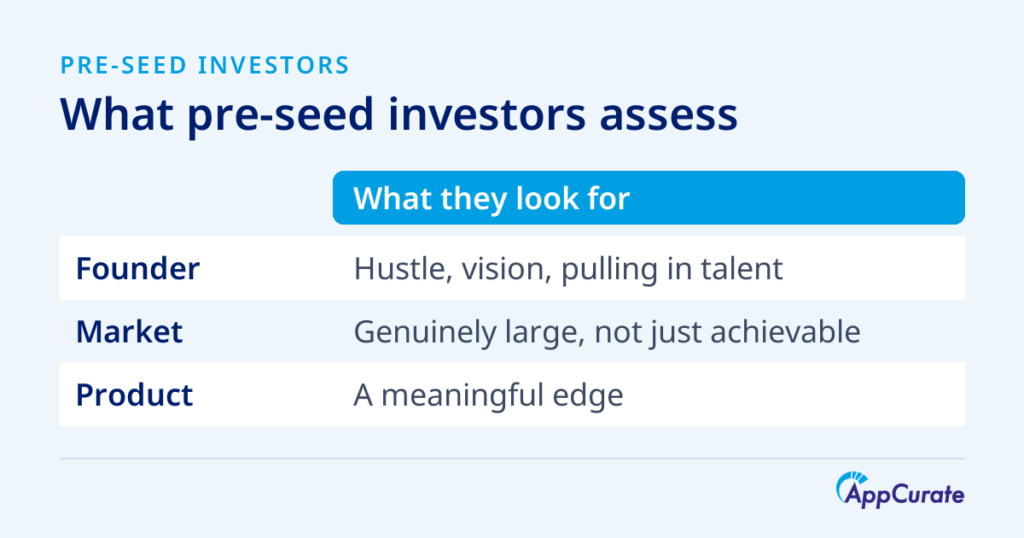
The chart below summarises the recurring criteria used across generalist Australian pre-seed funds.
| Criteria | What Investors Are Assessing |
|---|---|
| Founder quality | Hustle, vision, ability to attract talent and future capital |
| Market size | Whether the opportunity is genuinely large, not just achievable |
| Product differentiation | A meaningful edge over existing or obvious solutions |
| Stage & readiness | Comfort investing pre-product or pre-revenue if the other factors are strong |
Best Practices for Pitching Generalist Pre-Seed Funds
- Lead with founder-market fit — why you, specifically, are positioned to solve this problem.
- Quantify market size credibly; vague, oversized claims undermine confidence rather than building it.
- Be explicit about ambition — generalist pre-seed funds often self-select for founders who want to build something very large, not just a solid business.
- Don’t over-invest in product polish at the expense of the story; most pre-seed funds expect the product to still be evolving.
- Ask directly about a fund’s typical cheque size and stage focus before spending significant time on the pitch.
- Show, don’t just tell, evidence of hustle — a scrappy early customer conversation or a fast, low-cost prototype often lands better than a polished narrative alone.
- If a fund passes, ask what specifically didn’t land; a thesis or stage mismatch is different feedback to a genuine concern about the market or team.
It’s also worth remembering that generalist pre-seed investors see a very wide range of businesses, so pattern-matching plays a real role in their decisions. A founder who can clearly and quickly explain why their market is large and why they specifically are the right person to attack it tends to stand out more than one who requires several minutes of setup before making the core point.
Founder Perspective
Founder perspective: Don’t wait until you have “enough” traction to approach generalist pre-seed funds — many are explicitly built to back founders pre-product or pre-revenue. The bar isn’t proof the business already works; it’s conviction that you’re the right person to figure it out.
Key Takeaways
- Generalist pre-seed funds evaluate founders, market size and product differentiation consistently across sectors.
- Being pre-revenue or pre-product is normal at this stage, not a disqualifier.
- Ambition and vision matter as much as current data to many pre-seed investors.
- Valuation flexibility is common when a fund believes strongly in the founder and opportunity.
- Confirm a fund’s stage focus and typical cheque size before investing significant pitch effort.
FAQ
Do I need revenue to raise pre-seed funding in Australia?
No. Many generalist pre-seed funds are comfortable investing pre-revenue, and some invest pre-product, provided the founder and market opportunity are compelling.
What matters most at the pre-seed stage: product or founder?
Both. Founder quality typically weighs at least as heavily as the product itself at pre-seed, since the product is expected to evolve significantly after the raise.
How important is market size for a pre-seed pitch?
Very. Investors want confidence the opportunity is large enough to justify venture-scale returns, even if current traction is limited.
Will pre-seed investors negotiate hard on valuation?
Many are flexible, prioritising getting behind the right founder and opportunity over optimising valuation at this early stage.
Should I approach every pre-seed fund with the same pitch?
The core story can stay consistent, but confirming each fund’s stage focus and typical cheque size first avoids wasted pitches to poorly matched funds.
What’s the biggest reason pre-seed pitches get rejected?
Common reasons include a market seen as too small, unclear founder-market fit, or a mismatch with the fund’s stated stage or sector focus.
Conclusion
Generalist pre-seed investors consistently weigh founder quality, market size and product differentiation, and many are comfortable backing a team well before there’s meaningful revenue. Understanding these criteria — and being upfront about ambition rather than downplaying it — gives founders a sharper, faster path to the right pre-seed conversations.
For related reading, see our guides on types of startup investors in Australia, how to match your startup to a VC thesis, when to approach Australian VCs and how much should you raise.