
When and How to Run a Startup Capital Raise in Australia
Why timing and process discipline shape a capital raise, and how Australian founders can run a structured, higher-leverage fundraising process.

Introduction
When to raise and how to run the process are two of the most consequential decisions a founder makes during a capital raise — and both are more within a founder’s control than they might expect. Raising from a position of strength rather than desperation changes the entire negotiating dynamic, and a structured process consistently outperforms an ad hoc one.
This guide covers when Australian founders should consider raising, how to run a disciplined process once you start, and what a realistic timeline looks like.
Quick answer: The best time to raise is when momentum is strong and runway isn’t desperate, not when the bank balance forces the decision. Running a structured process — clear timelines, an open data room, and multiple investors engaged in parallel — creates negotiating leverage that a slow, one-investor-at-a-time approach doesn’t.
What Does “Timing” a Capital Raise Actually Mean?
Timing a raise means starting the process while you still have leverage — strong momentum, healthy runway and a credible growth story — rather than waiting until cash reserves force urgency. Founders with options negotiate very differently to founders with three months of runway left.
Why Timing and Process Discipline Matter
Negotiating leverage is largely a function of how much a founder needs the money right now. A founder with eight months of runway can walk away from a bad term sheet; a founder with two months usually can’t. Running a structured, time-boxed process compounds this advantage by creating competitive tension between investors rather than negotiating with them one at a time.
- Raising on momentum, not desperation, preserves negotiating leverage.
- A defined process timeline signals founder discipline to investors.
- Running multiple conversations in parallel creates competitive intensity that improves terms.
- Vetting investors properly protects a relationship that can last a decade or more.
Benefits of Raising Early, From Strength
- Stronger negotiating position — time equals options, and options mean better terms.
- Room to be selective — founders who don’t urgently need the money can choose investors on fit, not just speed.
- Less distraction risk — a well-timed raise with a clear process finishes faster, leaving more time for the business.
- Better long-term relationships — properly vetted investors are more likely to be genuinely useful later, not just present on the cap table.
Risks and Challenges of Poor Timing or a Loose Process
- Raising too late. Waiting until runway is critical removes almost all negotiating leverage and can force acceptance of weak terms.
- Raising too early at later stages. Taking on too much capital before finding a scalable growth motion can remove the constraints that force focus, leading a team to chase too many priorities.
- Running an undisciplined process. Taking investor calls ad hoc, without a clear timeline, often drags a raise out far longer than necessary.
- Skipping investor diligence. Picking a lead investor quickly without proper vetting risks a difficult, decade-long relationship with a partner who doesn’t show up well when things get hard.
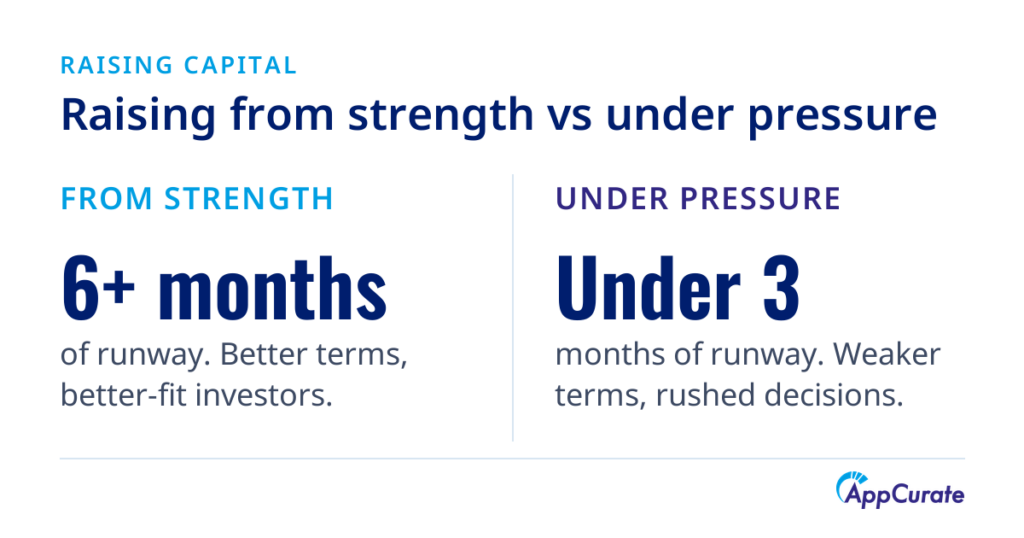
Raising From Strength vs Raising Under Pressure
The table below contrasts the two scenarios founders most commonly find themselves in.
| Factor | Raising From Strength | Raising Under Pressure |
|---|---|---|
| Runway remaining | 6+ months | Under 3 months |
| Negotiating leverage | High | Low |
| Investor selection | Founder can be selective on fit | Founder often accepts first credible offer |
| Process speed | Founder sets the timeline | Investors sense urgency and can slow-walk |
| Typical outcome | Better terms, better-fit investors | Weaker terms, rushed decisions |
Best Practices for Running the Process
- Set a clear process timeline upfront and communicate it to every investor — when the data room opens, how long Q&A runs, when you expect decisions.
- Run investor conversations in parallel rather than sequentially, to build genuine competitive tension.
- Keep your data room open and current, so momentum doesn’t stall waiting on document requests.
- Vet your lead investor as seriously as they’re vetting you — speak to founders in their portfolio, including ones who haven’t performed as well.
- Build a buffer into your timeline; processes almost always take longer than planned, especially in a cautious funding climate.
- Ask each investor upfront what their internal process looks like — investment committee cadence, typical diligence depth — so you’re not caught off guard by timelines that vary significantly between funds.
- Resist the urge to accept the first term sheet purely to end the process; a short additional conversation with a second interested investor can materially change the terms on offer.
None of this requires elaborate tooling. A simple shared tracker of who you’ve spoken to, what stage each conversation has reached, and when you expect a decision is usually enough to run a disciplined process for a seed or Series A raise.
Founder Perspective
Founder perspective: Decide your process before you take your first meeting, not after. Founders who tell investors upfront exactly how the raise will run — timeline, data room access, decision dates — consistently report less wasted time and stronger final terms than those who take calls reactively as they come in.
Key Takeaways
- Raise when you have momentum and runway, not when the bank balance forces the decision.
- Time equals negotiating leverage — the more runway you have, the more selective you can be.
- Running a structured, time-boxed process with parallel investor conversations builds competitive tension that improves terms.
- Vet your lead investor properly; it’s typically a decade-long relationship, not a one-off transaction.
- Build buffer into your raise timeline — most processes take longer than founders expect, especially in tougher markets.
FAQ
How much runway should I have before starting a raise?
Most experienced founders and investors suggest starting the process with at least six months of runway remaining, so the raise isn’t driven by desperation.
Is it better to raise more or less capital?
It depends on stage. Later-stage companies with a proven growth motion may benefit from raising ahead of an ambitious plan, while earlier-stage companies often benefit from constraints that force focus rather than taking on more capital than needed.
How long does a typical capital raise take in Australia?
Timelines vary, but founders should anticipate the process taking longer than expected, particularly in cautious funding climates, and build buffer into their planning accordingly.
Should I talk to multiple investors at once?
Yes. Running conversations in parallel, with a clear shared timeline, generally creates more negotiating leverage than sequential, one-at-a-time conversations.
How do I vet a potential lead investor?
Speak to founders already in their portfolio, including ones who haven’t performed strongly — how an investor behaves in difficult periods is often the clearest signal of what they’ll be like as a long-term partner.
What’s the biggest timing mistake founders make?
Waiting until runway is critically low before starting the process, which removes almost all negotiating leverage right when a founder needs it most.
Conclusion
Timing and process discipline are two of the few parts of a capital raise a founder fully controls. Starting from a position of strength, running a structured process with real competitive tension, and properly vetting the investors you bring on board consistently produces better terms and better long-term partners than raising reactively under pressure.
For related reading, see our guides on when to approach Australian VCs, types of startup investors in Australia, SAFE vs priced equity rounds and raising capital and dilution.