
How to Find and Approach Investors for a Capital Raise
How Australian founders can find and approach angels, family offices and VCs, and why warm introductions convert far better than cold outreach.

Introduction
Finding the right investors is often harder than founders expect, especially on a first raise. Friends-and-family networks run out quickly, and the jump to angels, family offices and VCs requires a different approach — one built on relevance and warm introductions rather than volume of outreach.
This guide breaks down the main investor types Australian founders approach when finding investors for capital raising, what actually works when reaching out, and how to get more value from the investors you already have.
Quick answer: Finding investors in Australia usually means working through angels, family offices and VC funds, roughly in that order for early raises. Warm introductions consistently outperform cold outreach, and a well-managed relationship with existing investors is often the fastest path to your next round.
What Does “Finding Investors” Actually Involve?
Finding investors means identifying the angels, family offices and funds whose stage, sector and cheque size genuinely match your business, then reaching them through a channel they trust. It is a targeting and relationship-building exercise, not a mass-outreach one — a short list of well-matched investors converts better than a long list of generic contacts.
Why Investor Targeting Matters
Every investor type has a different mandate, decision process and risk appetite. A family office focused on property won’t engage with a pre-revenue SaaS pitch, no matter how strong the deck is. Founders who research mandates before reaching out save time on both sides and build a reputation for being easy, well-prepared people to deal with — which matters in a small market where investors talk to each other.
- Angels invest personal capital and can move faster than a fund, but vary widely in sophistication.
- Family offices range from conservative (property-heavy) to adventurous (active VC allocations) depending on who runs them.
- VC funds are usually stage-or sector-focused, and receive far more inbound than they can act on.
Benefits of a Targeted Approach
- Higher response rates — investors engage more with pitches clearly relevant to their mandate.
- Faster meetings — warm introductions convert to a first conversation far more often than cold outreach.
- Better long-term fit — investors who match your stage and sector are more likely to add useful input, not just capital.
- Protected reputation — a small, well-targeted list avoids the reputational cost of generic mass outreach in a tightly networked market.
Risks and Challenges When Finding Investors
- Cold outreach fatigue. Generic cold emails and LinkedIn connection requests rarely convert and can mark a founder as untargeted.
- Wasting time on mismatched investors. Pitching a fund that only invests at Series A, or a family office with no venture allocation, burns time neither side gets back.
- Unrealistic expectations. Founders who ask for terms out of step with current market conditions signal a lack of preparation and reduce their credibility with the investors they do reach.
- Neglecting existing investors. Founders who only engage past investors when they need money again often find the relationship colder than expected.
Investor Outreach Channels Compared
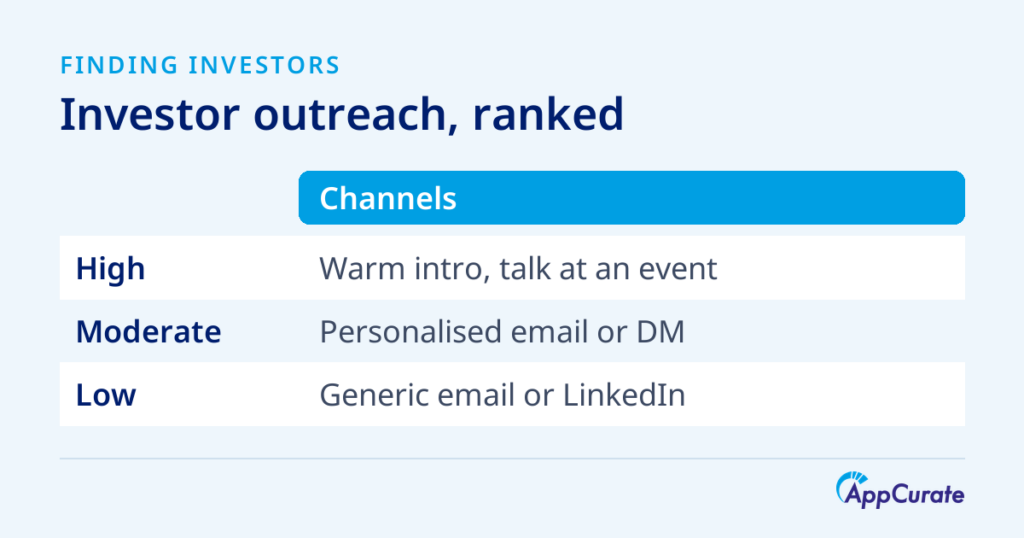
Some outreach methods consistently convert to real conversations; others rarely do, regardless of how well-written the message is.
| Outreach Method | Typical Effectiveness | Best Used For |
|---|---|---|
| Warm introduction | High | Any investor type, especially VCs |
| Personal relationship / event conversation | High | Angels and smaller funds |
| Personalised cold email or DM | Moderate, inconsistent | Investors who publicly invite direct contact |
| Generic cold email | Low | Rarely effective on its own |
| Generic LinkedIn connection request | Low | Rarely effective on its own |
Best Practices for Finding and Approaching Investors
- Build a simple CRM of target investors, qualified by stage, sector and cheque size before you start outreach.
- Check whether a fund or angel has already backed a competitor — they’re unlikely to invest again in the same category.
- Map your network for connectors, then extend to second-degree connections if there’s no direct path.
- Keep expectations realistic on valuation and raise size relative to current market conditions.
- Send regular updates to existing investors between rounds, so a future raise is never a surprise and they’re primed to help.
- Research the specific partner, not just the fund — check what they’ve backed before, what they’ve written or said publicly, and whether your stage and sector genuinely fits their current focus.
- Ask existing investors directly who else they’d recommend you talk to; a specific, targeted ask usually gets a better response than a general “know anyone who might invest?”.
It’s also worth remembering that a “no” from an investor isn’t necessarily permanent. Funds and angels who pass at one stage sometimes come back once a company has more traction, particularly if the founder kept them lightly updated rather than disappearing after the rejection.
Founder Perspective
Founder perspective: Treat your existing investors as part of the next round’s distribution channel, not a group you reactivate only when you need money. Founders who send consistent updates between raises find that existing investors introduce them to new ones, review decks before they go out, and often re-invest without much persuasion at all.
Key Takeaways
- Angels, family offices and VC funds each have different mandates, speed and sophistication — research before you pitch.
- Warm introductions and personal relationships convert far better than cold outreach for finding investors.
- A short, well-qualified investor list beats a long, generic one.
- Existing investors are one of the fastest paths to new investors, but only if kept engaged with regular updates.
- Realistic expectations on valuation and terms protect a founder’s credibility across a tightly networked investor community.
FAQ
What’s the best way to find investors as a first-time founder?
Start by mapping your existing network for connections to angels or funds, then build a short, qualified list of investors whose stage and sector match your business before reaching out.
Do cold emails to investors ever work?
Occasionally, if highly personalised and sent to an investor who has publicly invited direct contact. Generic cold emails rarely convert to a meeting.
Should I approach angels or VCs first?
Most Australian founders start with angels and family offices at pre-seed and early seed, moving to VC funds once there’s enough traction to support a fund’s typical mandate.
How do I know if a family office is a good fit?
Research their typical allocation and past investments. Family offices vary from conservative, property-focused vehicles to active venture investors, and pitching the wrong type wastes time on both sides.
How often should I update existing investors?
Regular investor updates — commonly monthly or quarterly — keep existing investors engaged and ready to help with introductions or re-investment when the next raise comes around.
Is a LinkedIn connection request a good way to reach an investor?
Rarely on its own. A generic connection request gives an investor little context, so a personalised message with relevant detail about your business performs better, though a warm introduction still outperforms both.
Conclusion
Finding investors in Australia is less about casting a wide net and more about identifying the right angels, family offices and funds for your stage and sector, then reaching them through channels that actually convert — chiefly warm introductions and genuine relationships. Combined with disciplined, regular communication with existing investors, this approach consistently outperforms broad, generic outreach.
For related reading, see our guides on types of startup investors in Australia, when to approach Australian VCs, what makes a great founder-investor relationship and deal sourcing for angel investors.