
Australian Startup Funding: What Recent Deals Reveal for Investors
What recent Australian deals, from AI scale-ups and acquisitions to government-backed deep tech and early rounds, reveal about where capital is flowing.

Introduction
Australian startup funding has covered a lot of ground in recent weeks: a high-profile acquisition, a very large AI round, a software company passing $400 million in annual recurring revenue, and dozens of smaller raises from pre-seed to Series C. Taken one at a time, each headline is a single data point. Read together, they show where investors are placing capital and where founders are finding it.
This guide breaks down the patterns in recent Australian deals, what each one can signal for investors, and how to read deal news without over-reading it.
Quick answer: Recent Australian startup funding points to three clear patterns: fast-scaling AI companies attracting very large rounds, deep-tech and climate businesses co-funded by government, and a steady flow of small pre-seed and seed rounds. A major acquisition also shows Australian companies can still return capital to investors.
What Do Recent Deals Show About Australian Startup Funding?
Australian startup funding is currently shaped by AI-native scale-ups, government-backed deep tech and a steady base of early-stage rounds. Each group attracts different investors and carries different risks, so they are best read separately rather than as one market trend.
AI-native companies are scaling quickly
Model ML, a company building AI agents that carry out investment banking research and analysis work, reportedly raised a $250 million Series B. It also reported annual recurring revenue (ARR) up 12 times year on year and daily active users up 26 times in the September 2026 quarter.
Employment Hero has passed $400 million in ARR after adding roughly $100 million over the past 12 months. The company reports that using AI agents across product, go-to-market and customer experience lifted revenue per employee by 33 per cent.
The common thread is agents that do work rather than answer questions. For investors, that shifts the diligence question from “does it use AI?” to “does the product replace measurable labour and can the numbers prove it?”
Exits are returning capital
me&u the Melbourne hospitality ordering company formerly known as Mr Yum, has been acquired by OpenTable in a deal reported at about $450 million. The company traded through venue lockdowns in 2020 and 2021 and later expanded into the United Kingdom and the United States.
Exits like this matter because they return capital to funds and encourage limited partners to commit to the next fund. A single sale does not make a trend, but it supports the case that Australian software and marketplace companies can reach strategic buyers.
Government capital is backing deep tech and climate
Several recent rounds included public money alongside private investors:
- Clutch Industries, a Victorian manufacturer of portable batteries, received $6.77 million from the Australian Renewable Energy Agency (ARENA).
- Quantum Brilliance received a further $10 million from the National Reconstruction Fund.
- Provectus Algae, a livestock methane agtech company, closed a $6.3 million Series A extension backed by the Queensland Government.
- Celosia Therapeutics, a motor neurone disease biotech, secured $2 million as part of a group of six NSW startups awarded state commercialisation grants.
Government money often arrives earlier and on different terms than venture capital, which can reduce dilution for founders and improve the risk profile for investors who follow. Our guide to pre-seed funding for Queensland startups covers how these programs work in more detail.
Early-stage rounds keep the pipeline moving
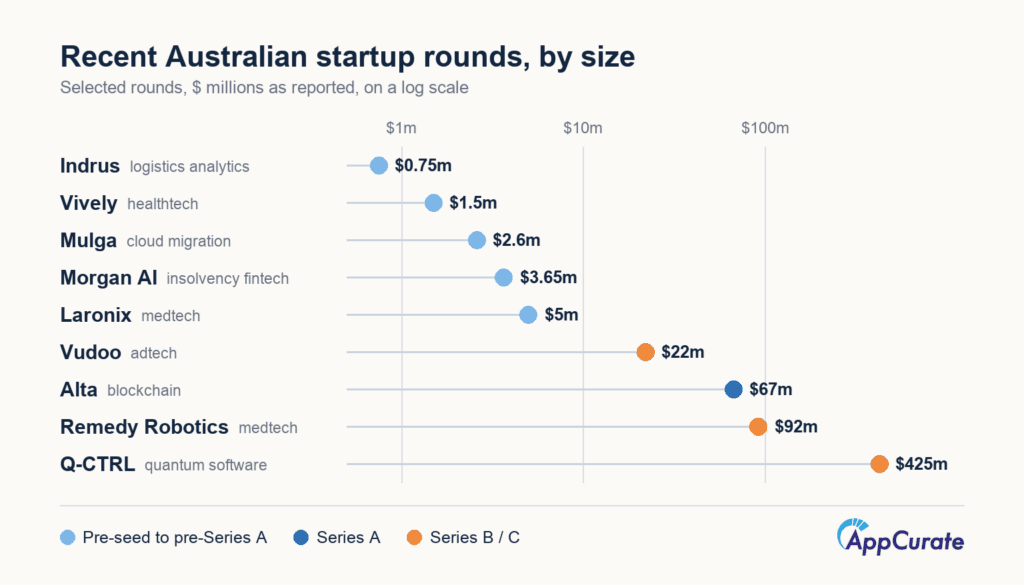
At the other end of the market, small rounds continue across sectors. Recent examples include Indrus, a Perth logistics analysis company raised $750,000 pre-seed; Vively, a healthtech startup raised $1.5 million pre-seed; Mulga, a Queensland cloud migration company raised $2.6 million pre-seed; and Morgan AI, an insolvency fintech raised $3.65 million in a seed round.
Later-stage rounds are also active, including a $22 million Series B for adtech company Vudoo; $67 million Series A for blockchain company Alta; $92 million Series B for medtech company Remedy Robotics; and $425 million Series C for quantum software company Q-CTRL at a $1.4 billion valuation. The chart at the top of this article compares these round sizes by stage.
Why These Patterns Matter for Investors
Deal patterns help investors see which sectors are attracting follow-on capital, which stages are getting crowded and where non-dilutive funding is changing the economics. They are not a forecast, but they give useful context for portfolio construction, fund selection and conversations with founders.
- Follow-on signals. Later-stage rounds in sectors you hold early can show where your portfolio companies may find their next investors.
- Valuation context. Large rounds and acquisitions give reference points for pricing, even though no two companies are identical.
- Liquidity routes. Strategic acquisitions show a path to returns beyond a public listing.
- Policy direction. Government-backed rounds show where public funding is currently focused, such as clean energy, advanced manufacturing and quantum technologies.
Benefits of Tracking Deal Patterns
- Spot sectors gaining momentum before they appear in fund marketing materials.
- Ask sharper diligence questions by comparing a company’s metrics with what comparable businesses report publicly.
- Identify co-investors, including government agencies, who can reduce capital intensity in early rounds.
- Calibrate expectations for round sizes at each stage.
Risks and Limits of Reading Deal News
- A single deal is not a trend. Large, headline-grabbing rounds are not representative of the typical Australian startup.
- Reported figures vary. Round sizes, valuations and currencies are often reported without full detail, so confirm the amount and currency in the original announcement before relying on a number.
- Metrics are usually self-reported. Growth multiples and ARR figures typically come from the company and have not been independently audited.
- Theme concentration. A crowded theme such as AI can inflate valuations and compress returns for later entrants.
- Survivorship bias. Public announcements highlight winners, while most early-stage companies never announce an exit.
Recent Australian Deal Types Compared
The table below compares four deal types from recent announcements and what each can signal to an investor.
| Deal type | Recent example | What it can signal | What to check |
|---|---|---|---|
| Early-stage round | Indrus, Vively, Mulga | Founders can still raise pre-seed capital in practical, niche sectors | Traction, founder-market fit, round terms |
| Government co-funded round | Clutch Industries, Quantum Brilliance | Public capital is backing strategically important sectors | Grant conditions, commercialisation milestones, dilution |
| Late-stage growth round | Model ML, Q-CTRL, Remedy Robotics | Strong demand from large investors for companies with clear scale | Valuation, revenue quality, path to exit |
| Strategic acquisition | me&u and OpenTable | Buyers will pay for proven products and distribution | Deal terms, return to early investors, buyer rationale |
Best Practices for Investors Following Australian Startup Funding
- Track rounds by stage and sector, not just by size, so you compare like with like.
- Read the original announcement or filing to confirm the amount, currency, investors and stage.
- Separate government-backed rounds from purely private ones when comparing valuations and dilution.
- Ask founders in your portfolio what they are seeing from later-stage investors and acquirers.
- Treat growth multiples as claims to verify and ask for the underlying revenue and retention data in diligence.
- Revisit your assumptions after each major exit or large round to see whether your thesis still holds.
Actionable Checklist
- Confirm the stage and currency of every round you cite.
- Note whether public funding was part of the round.
- Record the sector and check how many peers raised in the same period.
- Compare reported growth with audited or investor-verified figures where possible.
- Add one lesson to your investment notes after each major announcement.
Investor Perspective
Investor perspective: Strong headline deals are encouraging, but they should prompt questions, not conclusions. Ask what a round says about the next investor in line, how much of the growth is repeatable, and whether public money or a strategic buyer changes the risk profile. Good portfolio decisions still rest on company-level diligence, not market noise.
Key Takeaways
- Recent Australian startup funding shows concentration in AI-native scale-ups, government-backed deep tech and steady early-stage rounds.
- Acquisitions such as me&u’s sale to OpenTable show that strategic exits can return capital to investors.
- Government co-funding from bodies such as ARENA and the National Reconstruction Fund can change dilution and risk for early-stage investors.
- Reported metrics and round sizes should be verified against original announcements before they inform an investment decision.
- Compare deals by stage and sector, and use them as context rather than a forecast.
FAQ
What is Australian startup funding?
Australian startup funding is the capital Australian startups raise from venture capital funds, angel investors, corporate investors and government programs, usually in stages from pre-seed through to Series C and beyond.
Where does most Australian startup funding come from?
It comes from a mix of venture capital funds, angel investors, family offices, corporate investors and government programs. The mix shifts by stage: angels and early-stage funds are common in pre-seed and seed rounds, while larger funds usually lead later-stage rounds.
How does government funding fit alongside venture capital?
Agencies such as ARENA and the National Reconstruction Fund can invest or grant funds alongside private investors, particularly in areas such as clean energy and advanced manufacturing. The Research and Development Tax Incentive also reduces the cost of eligible research for companies.
Do acquisitions count as successful exits for investors?
Yes. A trade sale can return capital to investors in the same way a public listing can, although returns depend on the sale price, the investor’s entry valuation and their ownership stake at the time.
Should investors follow the AI funding trend?
AI is attracting a large share of recent capital, but a crowded theme can raise prices and compress returns. Focus on whether a company’s product replaces measurable work and can show retention, margins and growth data.
How can investors verify reported funding figures?
Check the company’s own announcement, the lead investor’s announcement and any available filings with ASIC, then confirm the stage, currency and participating investors before relying on a number.
Conclusion
Recent Australian startup funding shows several engines running at once: AI companies scaling quickly, public money backing deep tech, strategic buyers paying for proven products, and founders still raising early capital in practical sectors. For investors, the useful skill is not predicting the next headline but reading each deal in context, by stage, sector and source of capital.
For related reading, see our guides on how pre-seed venture funds are structured, Australia’s startup capital market, how lead and co-invest models shape a capital raise and what an ESVCLP is.