
How Fund Managers and Syndicates Raise Capital in Australia
How Australian fund managers and syndicates structure, license and raise capital, covering VCLP, ESVCLP, AFSL cover and LP compliance requirements.

Introduction
Fund managers and syndicate leads raising capital in Australia face a different set of problems to founders — legal structuring, licensing and investor compliance sit alongside the actual work of sourcing deals and backing companies. Getting the structure wrong, or under-investing in compliance, can slow a raise or create liability that surfaces years later.
This guide covers how Australian fund managers, syndicate leads and angel groups typically structure and run their own capital raising, from legal vehicle through to ongoing investor reporting.
Quick answer: Australian fund managers and syndicates raise capital through structures such as a VCLP, ESVCLP or unit trust, operate under an AFSL (their own or as an authorised representative), and must meet LP compliance obligations including KYC, AML and DDO before accepting investor capital.
What Does Capital Raising Look Like for a Fund or Syndicate?
Raising capital as a fund manager or syndicate lead means bringing together limited partners (LPs) — angels, family offices, wholesale investors — under a legal structure that pools their capital for investment in startups. Unlike a single startup raise, this involves choosing a fund structure, securing regulatory cover, and running ongoing compliance and reporting for every LP on the register.
Why Structure and Compliance Matter Early
The legal structure a fund manager chooses affects tax treatment, LP eligibility and how the fund can be marketed. Getting it wrong after LPs have already committed capital is expensive and sometimes impossible to unwind cleanly. Compliance obligations aren’t optional extras — they determine whether a fund can legally accept investor money in the first place.
- The right structure affects tax outcomes for both the fund and its LPs.
- AFSL cover (own licence or as an authorised representative) is required before soliciting most investor capital.
- LP compliance (KYC, AML, wholesale investor verification, DDO) must be completed before capital is accepted, not after.
- Clear LP reporting builds the track record that makes the next raise easier.
Benefits of Getting the Structure Right From the Start
- Faster fund launches — a clear structure avoids costly rework once LPs have already committed.
- Investor confidence — sophisticated LPs and family offices expect proper licensing and compliance as a baseline, not a bonus.
- Cleaner tax outcomes — structures like ESVCLPs offer tax concessions to eligible investors, which can help close a raise.
- Reputation and track record — professional fund administration and reporting make the second and third fund easier to raise than the first.
Risks and Challenges for Fund Managers and Syndicates
- Choosing the wrong vehicle. A structure that doesn’t match the fund’s investment thesis or investor base can limit flexibility or create unfavourable tax outcomes.
- Licensing gaps. Operating without appropriate AFSL cover exposes both the manager and LPs to regulatory risk.
- Compliance debt. KYC, AML and DDO obligations that are skipped early tend to resurface, and are far more expensive to fix retroactively.
- Administrative overload. Fund managers who try to run capital calls, distributions and LP reporting manually often find it consumes time that should go toward sourcing deals.
- Inconsistent LP communication. Sporadic reporting erodes LP confidence and makes the next capital raise harder.
Fund Structures Compared
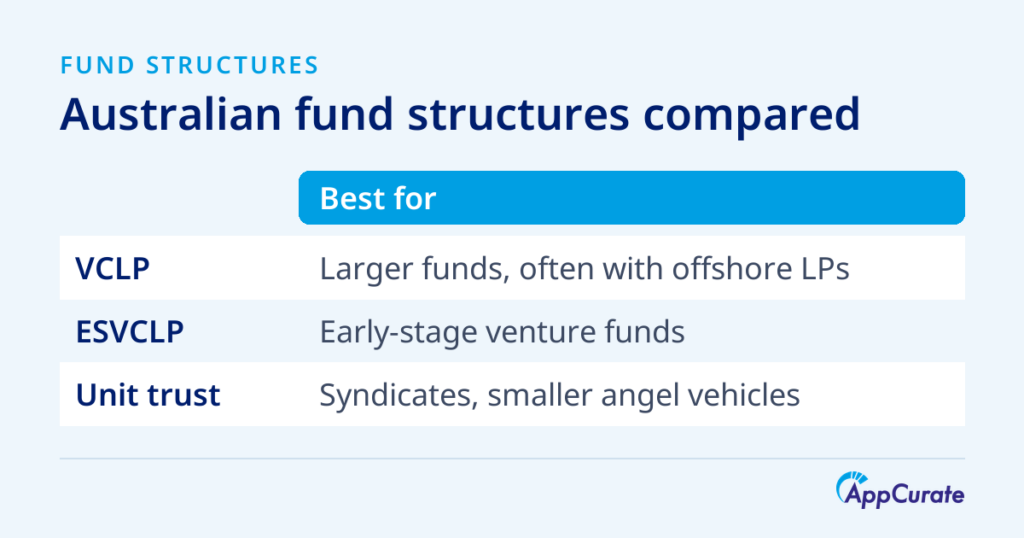
The table below summarises how the main Australian fund vehicles differ.
| Structure | Typical Use Case | Tax Treatment | Investor Base |
|---|---|---|---|
| VCLP | Larger venture funds, often with offshore LPs | Flow-through, exempt from tax on eligible venture capital investments | Wholesale and institutional |
| ESVCLP | Early-stage venture funds | Flow-through plus tax exemption on eligible gains for LPs | Wholesale and institutional |
| Unit trust | Syndicates and smaller angel vehicles | Flow-through, standard trust taxation | Wholesale, sophisticated and some retail-adjacent structures |
Best Practices for Raising and Administering Capital
- Confirm your legal structure and AFSL pathway before approaching LPs, not after commitments start coming in.
- Build KYC, AML and wholesale investor verification into onboarding from the first LP, rather than retrofitting it later.
- Keep the cap table and register of LP commitments current at all times, especially across multiple capital calls.
- Send LPs regular, consistent reporting — quarterly updates and annual statements build the track record for the next fund.
- Separate the administrative workload (fund accounting, trustee duties, compliance) from the investment workload wherever possible, so deal sourcing doesn’t suffer.
- Document a clear Target Market Determination for the fund early, since DDO obligations require it before capital can be accepted from investors in the target class.
- Plan the fund’s tax and reporting calendar (ATO obligations, LP tax statements) at launch rather than reconstructing it under time pressure at year end.
Many first-time managers underestimate how much of the first twelve months goes into structure and compliance rather than deal sourcing. Budgeting time and, where useful, outsourcing fund administration and trustee services from day one tends to pay for itself in faster capital calls and fewer LP queries later.
Investor Perspective
Investor perspective: LPs increasingly treat operational rigour as a signal of manager quality, not just track record. A fund manager who can show clean compliance, consistent reporting and a properly licensed structure earns trust faster than one leading purely with return projections — particularly from family offices and wholesale investors who have seen poorly run vehicles before.
Key Takeaways
- Fund and syndicate capital raising requires a legal structure (VCLP, ESVCLP or unit trust) matched to the investor base and investment thesis.
- AFSL cover, either a manager’s own licence or as an authorised representative, is generally required before soliciting investor capital.
- LP compliance — KYC, AML, wholesale verification and DDO — should be built into onboarding from day one.
- Consistent LP reporting is one of the strongest drivers of a manager’s ability to raise a second and third fund.
- Separating fund administration from deal sourcing protects the time that actually drives returns.
FAQ
What is a VCLP in Australia?
A Venture Capital Limited Partnership is a fund structure offering flow-through tax treatment and, for eligible investments, tax exemptions, commonly used by larger Australian venture funds with wholesale or offshore LPs.
How is an ESVCLP different from a VCLP?
An ESVCLP (Early Stage Venture Capital Limited Partnership) is designed for earlier-stage investing and offers eligible investors a tax exemption on gains, in addition to the flow-through treatment shared with a VCLP.
Does a syndicate need its own AFSL?
Not necessarily. Many syndicate leads operate as a Corporate Authorised Representative under another entity’s AFSL rather than holding their own licence, which can be faster to set up.
What compliance checks are required before accepting LP capital?
At minimum, KYC identity verification, AML screening, wholesale or sophisticated investor status verification, and Design and Distribution Obligations (DDO) checks appropriate to the fund’s target market.
How often should fund managers report to LPs?
Quarterly updates plus an annual report are standard practice in the Australian market, in addition to notices required around specific events such as capital calls or distributions.
Can a syndicate raise capital from retail investors?
Most Australian syndicates and funds are structured for wholesale and sophisticated investors, since retail fundraising triggers significantly more disclosure and licensing obligations.
Conclusion
Capital raising for a fund or syndicate is as much a structuring and compliance exercise as it is a fundraising one. Choosing the right legal vehicle, securing appropriate AFSL cover, and building compliant LP onboarding and reporting from the outset gives Australian fund managers a foundation that supports not just the first raise, but the next one too.
For related reading, see our guides on angel investing fundamentals, deal sourcing for angel investors, the Australian venture capital market and types of startup investors in Australia.