
Capital Raising Documents Every Australian Startup Needs
A practical checklist of the pitch deck, data room, term sheet and legal documents Australian founders need before and during a capital raise.

Introduction
Most founders start thinking about capital raising documents only once an investor asks for them — and by then, scrambling to build a data room or fix a messy cap table has already cost momentum. Getting the paperwork in order before the first meeting is one of the simplest ways to speed up a raise and avoid awkward gaps during due diligence.
This guide walks through the documents Australian founders actually need at each stage of a capital raise, what each one is for, and the most common mistakes that slow deals down.
Quick answer: A typical Australian capital raise needs a pitch deck, a data room, a term sheet, an investment instrument (SAFE, convertible note or share subscription agreement), a shareholders’ agreement and an up-to-date cap table. Having these ready before approaching investors shortens the process and signals founder readiness.
What Documents Do You Need to Raise Capital in Australia?
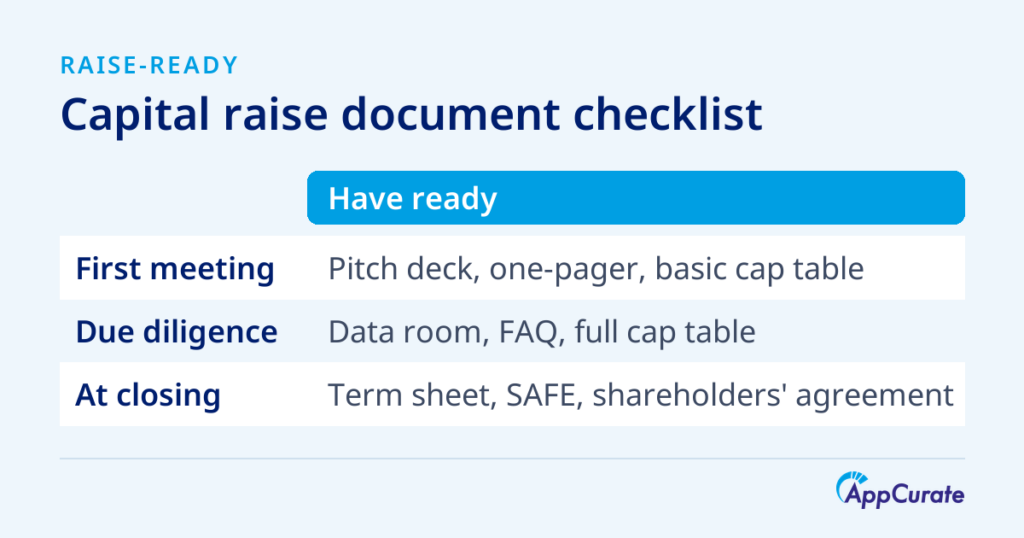
Capital raising documents fall into three groups: materials that get you the first meeting (pitch deck, one-pager), materials that support due diligence (data room, financials, cap table), and legal documents that close the round (term sheet, investment instrument, shareholders’ agreement). Founders who prepare all three before outreach begins move through a raise noticeably faster.
Why Document Readiness Matters
Investors read document readiness as a proxy for operational discipline. A founder with an organised data room and a clean cap table signals they can run a company with the same rigour once the money lands. A founder scrambling to produce basic financials mid-diligence signals the opposite, regardless of how strong the product is.
- Readiness shortens the time between first meeting and term sheet.
- A clean cap table avoids awkward surprises during legal due diligence.
- Standard, well-understood instruments (SAFE, convertible note) reduce legal back-and-forth.
- Having answers ready to common diligence questions keeps investor momentum from stalling.
Benefits of Being Raise-Ready Early
- Faster process — less time spent producing documents on request, more time spent in investor conversations.
- Stronger negotiating position — a founder who isn’t scrambling can hold firmer on terms.
- Fewer surprises — cap table and legal issues surface early, when they’re cheap to fix, not during a term sheet negotiation.
- Better investor experience — a well-run process is one of the signals experienced investors use to judge founder quality.
Risks of Being Under-Prepared
- Diligence delays. Missing financials, contracts or IP assignment documents can stall a raise for weeks at the worst possible time.
- Cap table surprises. Unresolved option pools, undocumented verbal commitments or missing share issuances can unwind a term sheet if discovered late.
- Weak negotiating position. Founders who need documents built from scratch mid-process have less leverage to push back on terms.
- Lost credibility. Investors talk to each other. A messy process with one fund can affect how a founder is perceived by the next.
Capital Raising Documents at a Glance
The table below summarises the core documents most Australian raises require, and when each one becomes relevant.
| Document | Purpose | Typically Needed | Legally Binding? |
|---|---|---|---|
| Pitch deck | Introduces the business, market and ask | Before the first meeting | No |
| Data room | Centralises financials, contracts, IP and cap table for diligence | Once an investor shows real interest | No |
| Cap table | Shows current and fully diluted ownership | From day one, kept current | No |
| Term sheet | Outlines proposed valuation, structure and key rights | After an investor decides to proceed | Mostly non-binding (except exclusivity/confidentiality clauses) |
| SAFE / convertible note | Investment instrument used before a priced round | Pre-seed to early seed raises | Yes |
| Shareholders’ agreement | Governs rights and obligations between shareholders | Priced equity rounds | Yes |
Best Practices for Building Your Data Room
A data room doesn’t need to be exhaustive to be effective — it needs to answer the questions investors ask most often, laid out clearly enough that they can self-serve.
- Keep a current cap table showing fully diluted ownership, including any option pool.
- Include 12–24 months of financials or, for pre-revenue companies, a clear budget and burn rate.
- Store signed contracts, IP assignment agreements and any existing SAFEs or notes together.
- Prepare a short business FAQ covering the questions investors ask repeatedly, so you’re not answering the same thing in every call.
- Update the data room monthly during an active raise so nothing feels stale by the time a fund runs diligence.
- Separate “must-have” documents (financials, cap table, contracts) from “nice-to-have” supporting material (market research, competitor analysis), so investors can find the essentials quickly.
- Get a lawyer to sanity-check your SAFE, convertible note or shareholders’ agreement template before it goes to investors, even if you’re using a standard market document as the starting point.
None of this needs to be elaborate. A well-organised folder with a handful of clearly labelled sections usually serves a seed-stage raise just as well as an expensive, over-built data room — investors are assessing whether the information is there and easy to find, not how polished the software looks.
Founder Perspective
Founder perspective: Build your data room and get your cap table reviewed before you take a single investor meeting, not after someone asks for it. Founders who treat document readiness as part of the pitch — not paperwork that follows it — consistently close faster and negotiate from a stronger position.
Key Takeaways
- Capital raising documents split into three groups: outreach materials, diligence materials and legal closing documents.
- A clean, current cap table is one of the highest-leverage things a founder can maintain before a raise.
- SAFEs and convertible notes are the standard early-stage instrument; shareholders’ agreements come with priced rounds.
- Building the data room before outreach — not during diligence — shortens the raise and strengthens your negotiating position.
- A well-organised process is itself a signal of founder quality that experienced investors weigh heavily.
FAQ
What should be in a startup data room?
At minimum: a current cap table, financials or budget, key contracts, IP assignment documents, any existing investment instruments, and a short FAQ answering common investor questions.
Is a term sheet legally binding in Australia?
Most terms in a term sheet are non-binding and subject to due diligence and final documentation, though exclusivity and confidentiality clauses are usually binding once signed.
Do I need a shareholders’ agreement for a SAFE round?
Not usually. A shareholders’ agreement typically becomes relevant once a priced equity round issues shares and formal governance rights need documenting.
When should I start building my data room?
Ideally before your first investor meeting, so you’re not building it under time pressure once diligence begins.
What’s the difference between a SAFE and a convertible note?
Both let an investor put in money now and receive shares later. A convertible note is a debt instrument that typically carries interest and a maturity date; a SAFE is not debt and has neither.
How often should I update my cap table during a raise?
At minimum after every new commitment or instrument signed — an out-of-date cap table is one of the most common causes of diligence delays.
Conclusion
Capital raising documents aren’t a formality to sort out once an investor asks — they’re part of how a founder demonstrates readiness before the ask is even made. Building the pitch deck, data room and cap table properly before outreach, and understanding which legal instruments apply at each stage, is one of the most controllable ways to speed up a raise and protect leverage during negotiation.
For related reading, see our guides on SAFE vs priced equity rounds, types of startup investors in Australia, when to approach Australian VCs and raising capital and dilution.